
Once they’ve embarked on their business journey, every entrepreneur picks up business hacks along the way. Some learn tips and tricks early on, while others stumble upon these strategies after some time. But one thing’s for sure: Business owners are always learning. You can be in business for over 20 years and still be learning new things, especially when it comes to leveraging new technologies.
Starting a business isn’t easy, but getting advice from seasoned entrepreneurs makes it more straightforward. As an emerging entrepreneur, seek advice and mentorship from people in your industry as well as business owners at all stages of their careers. We’ve collected 21 small business hacks from successful entrepreneurs, some of whom we interviewed for our RealTalk series. Read on for their unique insights, but remember, not every business hack will be right for your business. The best entrepreneur tips are the ones you can test, tweak and turn into habits that fit the way you actually work.
- Start with the resources you already have before chasing outside funding, so you can launch with more focus, less pressure and a clearer sense of what your business truly needs.
- Use business growth hacks that help you test, learn and improve quickly instead of waiting until every idea feels perfectly polished.
- Protect your focus with simple productivity hacks for business owners, like no-phone work blocks, task batching and repeatable routines that make your day easier to manage.
- Build local visibility through in-person relationships, smart partnerships and printed materials that help customers remember, revisit and recommend your business.
- Turn repeat tasks into simple systems, like quick SOP videos or checklists, so your business can grow without every process depending on you.
1. Set aside time for funding
Venture capitalist and author Richard Harroch says, “It’s almost always harder to raise capital than you thought it would be, and it always takes longer. So plan for that.” This quote actually contains two important pieces of advice: that raising capital isn’t an easy, straightforward process, so you need to give yourself more time than you thought you’d need for it, and more broadly, that this is true for most aspects of building a business.
Don’t expect overnight results; be willing to invest the time and effort needed for a successful launch. This is one of those entrepreneur tips that applies far beyond money: Product development, hiring, marketing and customer trust usually take longer than your most optimistic plan.

RealTalk interview clip featuring Karen Blackwell
2. Start with your savings
The best place to start is with what you already have in your savings account, says Karen Blackwell, founder of Kanda Chocolates. She told VistaPrint, “The initial funding for my business came from my own savings. I had worked in executive roles in corporate America, so I had stock, I had all these different [personal] funding sources to pull from to start my business. And so, I started with my own money, and then eventually I got some grants throughout the years to further my business.”
So if you’re considering starting a business, you might have to use your savings initially before you find funding elsewhere. Starting with what you have can also force helpful discipline: You learn what is essential, what can wait and where every dollar works hardest.
3. You don’t need much to start
However, depending on your business model and plan, you probably don’t actually need much to get it up and running. Take inspiration from amarieacreates founder Ashley Addison, who told VistaPrint in a RealTalks interview, “My sister and I initially started our business by spending a couple hundred bucks on a Cricut, which is a cutting machine, and just using the printer we already had.” That is the beauty of scrappy business growth hacks: they lower the pressure to launch perfectly and make it easier to start learning from real customers.

amarieacreates tote bag via VistaPrint
4. “Don’t worry about funding”
Not every business will even need funding. “Don’t worry about funding if you don’t need it,” says Noah Everett, founder of Pingly and Twitpic. “Today it’s cheaper to start a business than ever.” Setting up a website can cost very little or even nothing with a website builder like Vista x Wix. Take advantage of these and other free online tools, like AI logo makers and cloud storage, to get your business up and running. You can always upgrade later.
5. “Embrace what you don’t know”
SPANX founder, Sara Blakely, advises entrepreneurs, “Embrace what you don’t know, especially in the beginning, because what you don’t know can become your greatest asset. It ensures that you will absolutely be doing things differently from everybody else.” This business hack guarantees that you’re bringing something fresh to your market instead of imitating what’s already there, consciously or subconsciously. Not knowing “the normal way” can sometimes help you ask better questions, spot gaps and create a customer experience that feels refreshingly different.
6. “Plant seeds of content”
Film producer and business executive, Amy Pascal, believes that “brands should think of themselves not as storytellers but as storybuilders.” Pascal’s top business hack, which she lives by, is to involve the community in building stories as opposed to just telling them: “We plant seeds of content and let our community build on it.” For small businesses, this could mean asking customers to share photos, review products, vote on new designs or show how they use your products in real life.
For Edy Massih of Edy’s Grocer, community is not a marketing add-on; it is the reason behind the work. When asked what makes running the business worth it, Edy points to “amplifying and uplifting my queer, Middle Eastern community.” That kind of purpose can help a brand feel rooted, specific and genuinely connected to the people it serves.
For a deeper dive into the process of launching a small business, check out this case study of a vintage clothing brand launching.
7. “Content is fire; social media is gasoline”
Once you have your content, the next stage in growing brand awareness is social media. This is what bestselling author, marketing expert and founder of Convince & Convert, Jay Baer, meant when he said “Content is fire; social media is gasoline.” For small businesses, social media is king and essential for creating a strong brand. But it works best when it has a clear job, whether that is building trust, answering customer questions, showing product use cases or supporting seasonal campaigns like fall marketing ideas.
Tip box: Try a no-phone power hour. Digital notifications can break concentration fast. Research has suggested that every distraction costs you 23 minutes, so one of the simplest productivity hacks for business owners is blocking one hour a day with your phone in another room. Use that time for the work that moves the business forward: pricing decisions, customer follow-up, financial review, campaign planning or figuring out how to market a product before you start posting about it.
8. “User experience is everything”
To flourish in business, you need to understand the user and their needs. Twitter co-founder Evan Williams says that his top business hack is to prioritize UX. “User experience is everything. It always has been, but it’s undervalued and underinvested in. If you don’t know user-centered design, study it. Hire people who know it. Obsess over it. Live and breathe it. Get your whole company on board.”
For a small business, UX is not just your website. It is how easy it is to find your hours, choose the right product, place an order, understand shipping and get help when something goes wrong.

Source: business card via VistaPrint
9. Diversify your business card
Ashley Addison, founder of amarieacreates, told VistaPrint in a RealTalk interview that she uses “business cards as care cards and apparel cards. So every single cup, whether it’s glassware or a tumbler, gets a business card” with “all of my information on one side and the opposite side is how to care for your item for the best longevity.” This means Addison’s business cards aren’t “just a business card,” but a multi-purpose branding tool that considers the needs of both her customers and products.
You can apply the same idea to loyalty offers, thank-you notes, referral cards or QR codes that point customers to tutorials, reorder pages or reviews.
10. Prioritize in-person presence
“For us, for the type of business that we run, that in-person presence is extremely important,” Tlali Pani co-founder, Fabiola Lara, told VistaPrint. “I think other businesses are able to have this online platform and this strictly online community, and it works very well for them. But for us, what we’ve realized is that if we want to grow, we really have to be out there and be sharing our story. We have to explain what our products are, how they’re made.” E-commerce is great, but if you offer a tangible product, nothing can replace physical, in-person presence. People want to touch your product, so give them that opportunity through pop-up events and selling in local stores.
For The Herd, in-person presence is the whole point. Founders Trey Douyon, Ivan Lanz and Kevin Arrieta say the real reward is seeing people find connection through what they have built: “You realize you’re not just building a business, you’re building a space for people.” That is the kind of local influence that can turn a simple event, run club, pop-up or gathering into something customers want to come back to.
Use local micro-networking as a foot traffic hack. Partner with three complementary local businesses and create a shared physical bundle voucher. For example, a bakery, florist and gift shop could each offer a small discount when a customer visits the others. It is a low-cost way to turn nearby businesses into referral partners and make your brand visible in the places your customers already go.

VistaPrint interviewed the founders of Tlali Pani

11. Start with a store
Alexandra Scholtz, founder of WildFlora, also expressed the importance of real-world assets in a RealTalk interview. “We grew our business very organically, starting with our location. We found a really beautiful storefront… and put a lot of intention into the store itself to make sure it was attractive, clean and beautiful.” So if your business needs a physical location, then make sure you consider its importance in the early stages.
A storefront can become part of your marketing engine when your signage, window displays, product layout and printed takeaways all tell the same story.
12. Keep good company
“The fastest way to change yourself is to hang out with people who are already the way you want to be,” says LinkedIn co-founder, Reid Hoffman. Nobody is immune to being influenced, so surround yourself with fellow entrepreneurs and like-minded people you want to be influenced by, and you will see the effects on your business. This is especially helpful when you are learning how to expand a business because other owners can share the lessons, shortcuts and mistakes that do not always make it into polished success stories.
Maria Colalancia of Aperitivo puts it simply: “Having people in your corner is one of the most important business tools you can have.” Whether that is a mentor, collaborator, employee, fellow founder or trusted friend, the right people can help you make clearer decisions when you are too close to the problem.
13. “Ask for the sale”
“At the end of the day, it really is that, ask for the sale,” FRUITLOOTS co-founder David Cruz told VistaPrint. “When you’re networking, and you’re introducing yourself to other people, tell them what you do, tell them how you can help their business and say, ‘Here’s my business card. If you’d like to do some gift boxes through FRUITLOOTS, I’ll give you a discount on your first order.’” Although it can feel awkward at first, asking for sales is how you make them, so be forward and don’t miss a single opportunity. You do not have to be pushy; you just have to make the next step clear.
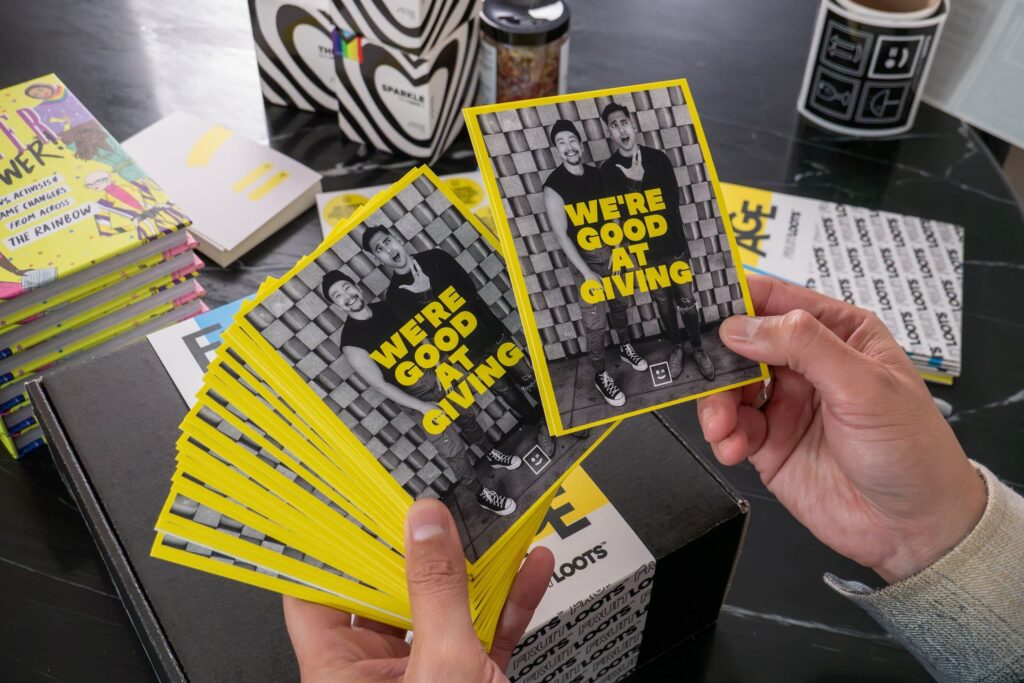
FRUITLOOTS postcards printed with VistaPrint
14. Cultivate relationships
“Networking is more about farming than it is about hunting. It’s about cultivating relationships,” says Ivan Misner, founder of BNI. This top business hack expresses the importance of nurturing business contacts to grow your small business. The relationship-first approach is one of the most durable business growth hacks because it can lead to referrals, collaborations, repeat orders and honest feedback.
15. Ask yourself, “What’s not working?”
Tlali Pani co-founder, Sabith Khan, advises entrepreneurs to consistently question how their business is going. He told VistaPrint his top business hack is “Really putting yourself to the grind and figuring out – okay, what parts of this is working, what’s not working?”
As a small business owner, you’re constantly receiving data about your business in the form of sales, leads and social media engagement. Analyze this data to understand how your business is really doing and use it to work out your next steps A simple weekly check-in can help: Look at what sold, what customers asked, what content worked and where time was wasted.

Sabith Khan with VistaPrint product in a RealTalk interview
16. “Improve, change and grow your business”
“If you don’t feel uncomfortable, then you actually should revisit what it is that you’re doing,” Allan Nguyen told VistaPrint in a RealTalks interview. According to the FROOTLOOTS co-founder, “You should always want to improve and change and grow your business.” This is an example of a growth mindset, one of the most crucial small business hacks for any entrepreneur to cultivate. A growth mindset recognizes that effort and hard work are the path to progress and welcomes opportunities for them. It also keeps you from treating your first idea as your final idea.
17. Experimentation is key
In a RealTalk interview, Karen Blackwell of Kanda Chocolate said, “Going into business is experimenting with everything and being willing to experiment with all those things. And for me, one of the things that I experimented with was all the relationships I could have.” This small business hack prioritizes the importance of experimentation in business, especially when it comes to relationships. Test small before you scale big: a new offer, pop-up event, email subject line or product bundle can teach you a lot without draining your budget.
That speed is one of the biggest advantages small businesses have. As Kiki Couchman and Elan Halpern of Sourmilk put it, “We’ll have an idea on a Monday morning and launch it that afternoon, which just doesn’t really happen at a bigger company.” When you can test quickly, you can learn quickly too.
18. “Hire out your weaknesses”
“We don’t have strengths everywhere. We do have weaknesses. Hire out your weaknesses,” advises the founder of WildFlora. No one is perfect, even successful entrepreneurs. So, VistaPrint ambassador Alexandra Scholtz’s top business hack is to work out what your weaknesses are and hire people who can handle these aspects of the business in your place.
Marcy Kenney of The Bright Spot/Golden Ceramics saw this firsthand when she brought in help with the numbers side of her business: “One of the best hires I made this year was someone to help with my bookkeeping and reporting. What I spent months agonizing over, she solved in about 10 hours.” Hiring support is not about admitting defeat. It is about giving yourself more room to do the work only you can do.
Turn delegation into documentation. Before you hand off a task, record yourself doing it once with a screen recording tool and walk through each step. That quick video becomes a simple SOP you can reuse for training, outsourcing and quality control. This kind of frictionless documentation is one of the most practical entrepreneur tips because it helps your business run without every answer living in your head.

WildFlora postcards printed with VistaPrint
19. Be persistent
When she was starting her chocolate business, Karen Blackwell “was looking for anyone who needed chocolate. I showed up at company meetings, and I would wake up at three in the morning, get on the call and talk to them about tasting chocolate.” If this tells entrepreneurs anything, it’s that you have to be persistent in the early days to make those contacts and get the word out there. Persistence does not mean doing everything forever; it means staying creative long enough to find the channels, customers and offers that work.
For Rachid Macer and Johnny Haiki of Nooly, motivation comes from noticing the small signs that the work is landing: “What keeps us going is the progress – whether that’s a sold-out batch, a repeat customer, or someone going out of their way to tell us they love the product.” Those moments matter because they show you what is worth building on.
20. “Don’t over-analyze”
Pinterest founder Ben Silbermann’s top business hack is, “Don’t take too much advice. Most people who have a lot of advice to give – with a few exceptions – generalize whatever they do. Don’t over-analyze everything. I myself have been guilty of overthinking problems. Just build things and find out if they work.” So many of the discoveries you’ll make will come through doing. Dive right in and let the lessons find you. The smartest hacks are only useful once you put them into practice.
21. AI is your friend
You can also look beyond generative AI and try agentic AI. Generative AI can help you draft emails, captions and product descriptions, but agentic AI tools can help you do work, not just write about it. For example, you might use AI-supported workflows to research leads, organize customer inquiries, send invoice reminders or summarize sales calls. These productivity hacks for business owners can free up time for higher-value decisions, as long as you review the output and keep customer data protected.
Helen Zhang of Ziggy’s Roman Cafe is already thinking this way, saying she is “excited to explore AI to automate systems and make smarter marketing loops.” That is the real opportunity: using AI to make your business more responsive, not just to create more content.

Tlali Pani business cards printed with VistaPrint
The branding power of business cards
You can find helpful business hacks about every aspect of running a business. One of the most valuable hacks, which is more of a non-negotiable, is having a clear brand identity. This includes a distinctive color palette and brand voice and of course, well-designed business cards.
The right tools, routines and relationships can make your business feel more focused and less overwhelming. Start with one or two small business hacks that solve a real problem, test them for a few weeks and keep the ones that help you save time, earn trust or reach more customers.
Small business hacks FAQs
What are the best productivity hacks for small business owners?
The best productivity hacks for business owners are simple, repeatable and easy to protect. Try a daily no-phone power hour, batch similar tasks together, automate routine follow-ups and create quick SOP videos for repeat processes.
How can I market my business with no money?
Start with the channels and relationships you already have. Ask happy customers for reviews, post useful behind-the-scenes content, partner with nearby businesses, attend local events and use every package, receipt or business card as a small marketing moment.
What are some growth hacks for startups?
Useful startup growth hacks include testing offers before investing heavily, creating referral incentives, building local partnerships, using AI to speed up research and turning customer questions into content. The goal is to learn quickly without overspending.
How do entrepreneurs save time on social media?
Entrepreneurs can save time by batching content creation, reusing one idea across several formats, scheduling posts in advance and using AI tools for first drafts. Keep your best energy for strategy, customer replies and real brand personality.
What are common mistakes when trying business hacks?
The biggest mistake is chasing every hack at once. Business hacks work best when they solve a specific problem, fit your customers and get measured. Test one change at a time so you know what actually helped.