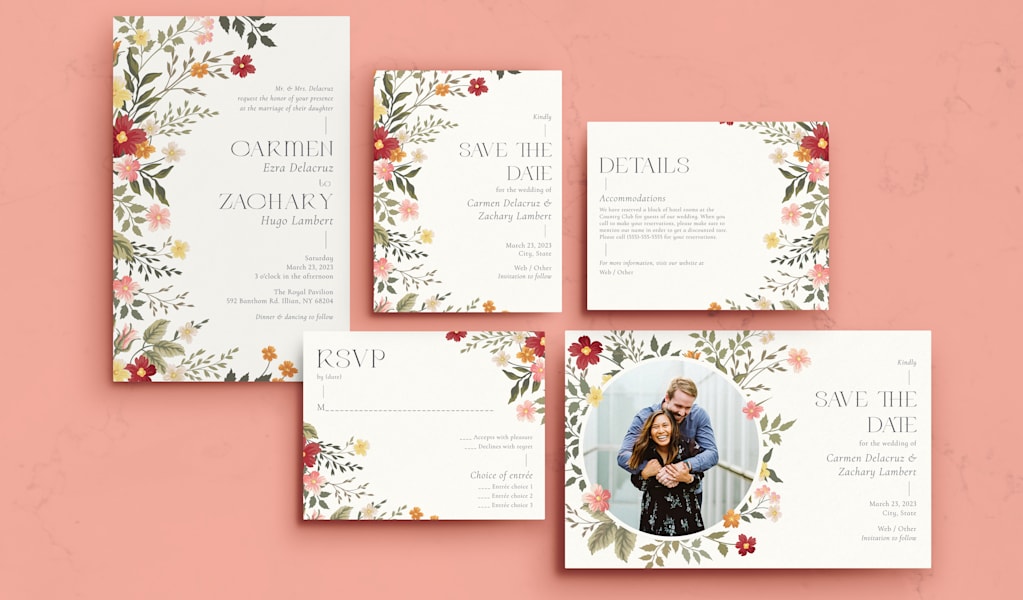
Once you’ve sent out save-the-dates, the next piece of wedding stationery your guests will receive is the official wedding invitation. Together, the wedding invite wording and design communicate what guests can expect from your upcoming wedding, from the tone of the day to the level of formality. Clear, thoughtful wedding invite wording helps guests understand the details, timing and expectations at a glance.
There can be some pressure to stick to tradition and etiquette in the wording of the invitation, which can make it challenging to make the invite feel personal to you. We’ve put together this guide to help you word any wedding invitation, whether formal or casual, with templates, practical examples, frequent pitfalls, etiquette guidance and modern wedding invitation challenges like blended families, inclusive language and non-traditional ceremonies.
- Wedding invite wording sets the tone for your celebration and helps guests understand what to expect, from the formality to the dress code.
- The best wedding invitations balance clear wording with a tone that reflects your relationship and wedding style.
- Different weddings call for different wording, whether you’re planning a formal, traditional ceremony or a casual, modern celebration.
- Thoughtful wording can help avoid common mistakes around missing RSVP deadlines, plus-one information, reception details and dress code.
- Pairing the right wording with the right design, layout and invitation suite makes your message clearer.

Line-by-line wording of a wedding invitation
A wedding invitation has a few jobs. The most important is to give guests all the details they need to prepare for your wedding, like the time, location and dress code. It also includes other information that could factor into whether a recipient attends, like whether plus ones or children are invited.
Wedding invitation wording and design can vary massively, but invites mostly include the same information. Take a look at these two wedding invite wording examples, one formal and the other more casual:

Source: Wedding invitation design by CLCreative via 99 designs by Vista

Source: Wedding invitation design by T o n k a via 99designs by Vista
In general, formal weddings tend to use traditional phrasing, script fonts and full sentences, while casual weddings, like a barefoot ceremony on a beach or an evening in a renovated factory, allow for more relaxed language, contractions and personality. The key is making sure your wording matches the experience you’re inviting guests to.

No matter what wedding style or level of formality you choose, we’ll break down each element of a wedding invitation, explaining what to include and how your wording can subtly shift the tone. As you brainstorm your wording, think about how you’ll present the following information:
Couple’s names
You and your partners’ names are the most stand-out information on the invitation. To draw the recipient’s eye first, the names should be the largest or brightest words on the page. More formal wedding invitations tend to include first, middle and surnames, and names can be listed in alphabetical order or any order that feels right.

Hosts
Traditionally, the couple’s parents host the wedding, rather than the couple themselves. So if you or your partner’s parents (or both) are paying for most or all of the wedding, you may want to include their names in the invitation as hosts. Of course, this can be omitted for more modern weddings where the couple is hosting.
If either set of parents are divorced, list them separately on your invitation. For example, “Catherine Hidalgo and Robert Scalia request the honor of your presence at the wedding of their daughter, Sarah Scalia.” If multiple people are hosting, list their names on separate lines to avoid confusion.
Date
The date is arguably the most important piece of information on the wedding invitation, so include it even if you’ve already sent out save-the-dates. You can choose to present the wedding date in numerical or word form, depending on how formal the tone of your wedding will be.
Haven’t sent out your save-the-date cards yet? Read our guide on save-the-date wording.
Time
After the date, include the time that the wedding proceedings will kick off. You can keep this simple and list the time numerically, like 2:00pm, 5pm or 3 o’clock in the afternoon, as is used in more casual wedding invite wording. If guests should arrive earlier, note this clearly to avoid late arrivals.

A modern wedding invitation template with a simple design and casual wording
Alternatively, the time is sometimes spelled out on more formal wedding invitations:
- At three o’clock in the afternoon
- At six o’clock in the evening
Location
Another key piece of information to include is where the ceremony and reception will be held. Here are a few wording examples:
- At the Sunrise Resort in Palm Springs, CA
- St. Mary’s Episcopal Church, Bethlehem, PA
- At our home [include address]
If the reception will be at another venue, make sure to mention this below or in an enclosure card. List all venues so guests can look them up. Knowing where to go is part of preparing to attend a wedding. For destination weddings, add the city and country to avoid any ambiguity.
Address and map
Include the venue’s address, and potentially even a map of how to get there on the back of the invitation or on a details card.
Website
Point guests in the direction of your wedding website by including the URL on the invitation. Here, they can find all of the information they need for the big day, as well as browse your registry, select meal options and RSVP.
Include a QR code that directs guests to your wedding website. QR codes are especially helpful for digital RSVPs and multi-day or destination weddings.

Reception to follow
A quick note along the lines of “reception to follow” lets guests know to plan for festivities after the ceremony. Here are a few ways to phrase this:
- Reception to follow
- Please join us for a cocktail reception afterward
- Dinner and dancing to follow
If the reception is at a separate venue, include the name and address here or on an enclosure card. An enclosure card is an additional piece of communication that’s sent alongside a wedding invitation and can include directions to the venue, and dress code, accommodation and RSVP information or guidelines for guests to follow at the venue.
RSVP
The invite should also let guests know how to RSVP, including instructions and the date to respond by. You can use a QR code to direct guests to the wedding website or an email address to send RSVPs to. RSVP details are often included on a separate RSVP card to keep the main invitation design uncluttered.

Dress code
You may include a brief description of your wedding’s dress code, such as:
- Black tie optional
- Cocktail attire requested
- Dress casual
- Creative black tie suggested
- Please dress to impress! Semi-formal attire requested.
- We’ll be on a beach, so please dress for the occasion!
If you aren’t sure how to describe the dress code you’d like, researching and using established terminology helps guests look up specific dress codes to avoid confusion and wardrobe mishaps.
Gifts
Give guests directions regarding wedding gifts, such as a QR code to your registry or a note about where you are registered. You can also request that guests abstain from giving gifts or direct them to a favored charity as an alternative, by using the following wording:
- In lieu of gifts, we request that guests make a donation to the local food bank
- No gifts, please; your presence is more than enough for us
Gift information is often placed on a details card or wedding website rather than the main invitation.

Parking instructions
On the invitation or enclosure card, include parking instructions for guests, whether you’re providing a shuttle from the accommodation to the venue or if there will be valet parking at the venue. Making this information clear can reduce stress on the day and help events start on time.
Plus ones
A wedding invitation includes important information about who is invited. Clear wedding invite wording eliminates any confusion about whether the invitation recipient may bring a plus one and/or their children.
When you invite a married guest or a guest in a serious relationship, invite them as a couple, not an individual and a plus one. Plus ones are reserved for guests who are single or newly dating a partner.
Include plus one information with the invitation, either on the enclosure card or the RSVP section of your wedding website. Guests can RSVP for themselves and their plus one if they have one.

Kids
The wedding invite wording should also mention whether children are welcome at the ceremony and reception. Choose wording that feels kind and clear. Polite phrasing helps avoid awkward conversations later.
Here are a few examples of appropriate wording regarding children, with varying formality levels:
- Please note, this will be an adults-only celebration.
- Parents need a break sometimes, so come ready to enjoy an adults-only celebration.
- Children are welcome! We can’t wait to celebrate with your whole family!
- The couple kindly requests an adults-only celebration.
- We respectfully request no children under 16.
Requests
State your request in polite, straightforward language that matches your chosen formality level. Here are examples of casual and formal phrasing for a common request:
- Let’s all be present together! Please leave your phone in your bag during the ceremony
- The couple requests that no phones be used during the ceremony
A quote
Wedding invitation and save-the-date quotes can also be meaningful additions. You might choose to use a quote to grab the recipient’s attention at the top of the page or to wrap the invitation up nicely in the final line. The quote can be romantic, funny, inspirational or taken from a favorite song, poem or book. Keep quotes short so they complement the invitation rather than overwhelm it.

Wedding invite wording examples by wedding style
Once you’ve decided what information to include, the next step is choosing wording that reflects the style and tone of your wedding. Subtle wording choices can signal the level of formality, your personality and what guests should expect from the day. Small wording changes can noticeably shift the mood of an invitation. Compare the difference below:
- Formal: “Mr. and Mrs. Jonathan Miller request the honor of your presence at the marriage of their daughter, Emily Rose Miller to Daniel Thomas Wright.”
- Casual: “Join us for the wedding of Emma and Jack!”
Both versions have the same purpose, but the first feels traditional and formal, while the second feels relaxed, celebratory and personal. Subtle wording choices like these help set expectations before guests even arrive.
Formal wedding invitation wording
Formal wedding invite wording can be the easiest option as it’s the most prescriptive tone to take for a wedding invitation. Avoid contractions and unnecessary words in a formal wedding invitation by sticking to traditional wording and formatting. Formal wording is well-suited to traditional venues, religious ceremonies and black-tie events.
Example:
Mr. and Mrs. Jonathan Miller
request the honor of your presence
at the marriage of their daughter
Emily Rose Miller
to
Daniel Thomas Wright
Saturday, the twenty-first of June
two thousand twenty-six
at half-past four in the afternoon
St. Andrew’s Church, Greenwich Village, New York City

Formal wedding invite template with the hosts’ names included
Casual wedding invite wording
Casual wedding invite wording works best when the language reflects how you naturally communicate, while still clearly sharing essential details. This style is especially popular for outdoor, intimate or non-traditional celebrations.
Example:
Emma and Jack
are getting married!
Join us for a relaxed celebration
Saturday, June 21, 2026
4:30 pm
The Riverside Gardens, Boston
Drinks and dancing to follow

Source: Wedding invite design by Creeventer via 99designs by Vista
Modern or minimalist wedding invite wording
Modern wedding invitations often use short lines, simple language and pared-back phrasing. This style pairs well with clean layouts and contemporary typography, as well as creative DIY wedding invitations.
Example:
Emma Carter & Jack Lewis
invite you to celebrate their wedding
June 21, 2026
At 6pm
The Old Dairy, Boston
Reception to follow
Destination wedding invitation wording
Destination wedding wording should clearly communicate travel expectations and direct guests to additional details online. Keep the invitation design clean and uncluttered and use a wedding website for logistics.
Example:
Together with their families,
Emma and Jack
invite you to join them in celebration
June 21, 2026
Lake Como, Italy
Please visit our wedding website for travel and accommodation details

Small and intimate wedding invite wording
For small, intimate weddings, wording can feel warm and personal while still remaining clear and respectful. This approach works well for limited guest lists or private ceremonies.
Example:
With great joy,
Emma and Jack
invite you to share a very special day
as they celebrate their marriage
June 21, 2026
At our home
Reception to follow
Same-sex and inclusive wedding invite wording
Inclusive wedding invite wording focuses on the celebration itself rather than traditional gender roles or assumptions. Names can be listed in any order that feels right to the couple.
Example:
Join us
to celebrate the marriage of
Emma Carter and Sophie Nguyen
Saturday, June 21, 2026
Chicago City Hall, Randolph Street, IL 60602
Common wedding invite wording mistakes, and how to avoid them
Even beautifully designed invitations can cause confusion if the wording isn’t clear. These are some of the most common wedding invite wording mistakes couples make and how to fix them before invitations go to print.

Being unclear about who is invited
One of the most common issues is vague guest wording, especially around plus-ones and children. Avoid relying on assumptions and make guest limits clear with names on the envelope and RSVP cards and forms that only allow responses for invited guests.
Forgetting to include RSVP deadlines or methods
Missing or unclear RSVP details can delay responses and complicate your planning. Always include a clear RSVP deadline and explain exactly how guests should respond, whether by mail, email or via your wedding website. Digital RSVPs and QR codes make it easier for guests to respond on time.
Omitting reception details
If guests are invited to both the ceremony and reception, say so explicitly. If the reception is at a different venue or starts later, that information should be impossible to miss. Use an enclosure or details card if space on the main invitation is limited.
Using wording that doesn’t match the formality of the event
Overly formal wording for a relaxed celebration or casual wedding invite wording for a black-tie event can set the wrong expectations. Your wedding invite wording should reflect the experience guests will have.
Read your invitation aloud and ask whether it sounds like the wedding you’re hosting.
Not specifying adults-only celebrations clearly or kindly
Guests appreciate clarity, but tone matters too. Polite, respectful wording helps avoid awkward conversations. Clarify whether your wedding is adults only on the invitation, RSVP card or wedding website.
Overcrowding the invitation with too much information
Trying to fit every detail onto the main invitation can overwhelm guests and clutter the design. A complete wedding invitation suite with a save-the-date card, main invite, RSVP card, details or enclosure card and wedding shower card (if you’re having one) keep the design of each piece of stationery clean and focused.

Match the wording to your wedding invitation design
An invitation’s second-most important job is to set the tone for the wedding. Typically, a wedding invitation incorporates design elements that communicate the couple’s chosen wedding aesthetic, like a monochrome invitation with a serif font for a sophisticated, minimalist wedding or a light-colored invite with botanical imagery for a relaxed wedding in natural surroundings.

Source: Nautical-themed wedding invitation design by Motiff Media® via 99designs by Vista.
Determining your theme and formality level for the wedding ceremony and reception are decisions you’ll make early on in the planning process. These decisions, such as whether your wedding will be a formal banquet hall dinner or a casual rooftop party, inevitably inform your wedding invitation design and wording. When wording and design are aligned, your guests immediately understand what kind of celebration they’re being invited to.
Ready to design your wedding invites? Read our ultimate guide to wedding invitation design.
Thinking about your invitation like a brand message can be helpful. Design choices like color palette, font, imagery and visual hierarchy communicate your values and the atmosphere you aim to create at your wedding. And just as luxury brands use more formal language and modern brands lean more conversational, your wedding invite wording should reflect the experience you’re creating. Ask yourself: What should guests feel when they open the envelope?
Guests will also encounter your wedding branding in your other communications, at pre-wedding parties and through day-of decorations, signage and cocktail napkins. Keeping wording and design consistent across your invitation suite, wedding website and day-of elements helps create a polished, cohesive experience.
How wording affects layout and your invitation suite
Your wedding invitation wording affects how your invitation is laid out, as well as its tone. Formal wedding invite wording often pairs well with centered layouts, clear visual hierarchy, script fonts and generous white space, while casual wording works nicely with playful layouts, asymmetry or modern typography.

Many couples print a full invitation suite rather than fitting everything onto one card. This typically includes:
- A save-the-date card so guests can reserve the day in advance
- The main invitation with ceremony details
- An RSVP card with response options
- A details or enclosure card for logistics like reception, dress code, parking or accommodation info
- A thank-you card to be sent out after the wedding to thank guests for celebrating with you
Find out how to show your guests appreciation in our guide to wedding thank-you card wording.
Including a link to a wedding website or QR code allows you to keep the main invitation uncluttered while still sharing all the information that guests need to know. These elements are often placed at the bottom of the invitation or on a separate details card to maintain a clean design.
Wedding invitation timing and logistics
Here’s everything you need to know about wedding invitation timing and logistics to make sure guests have everything they need with plenty of time to prepare.
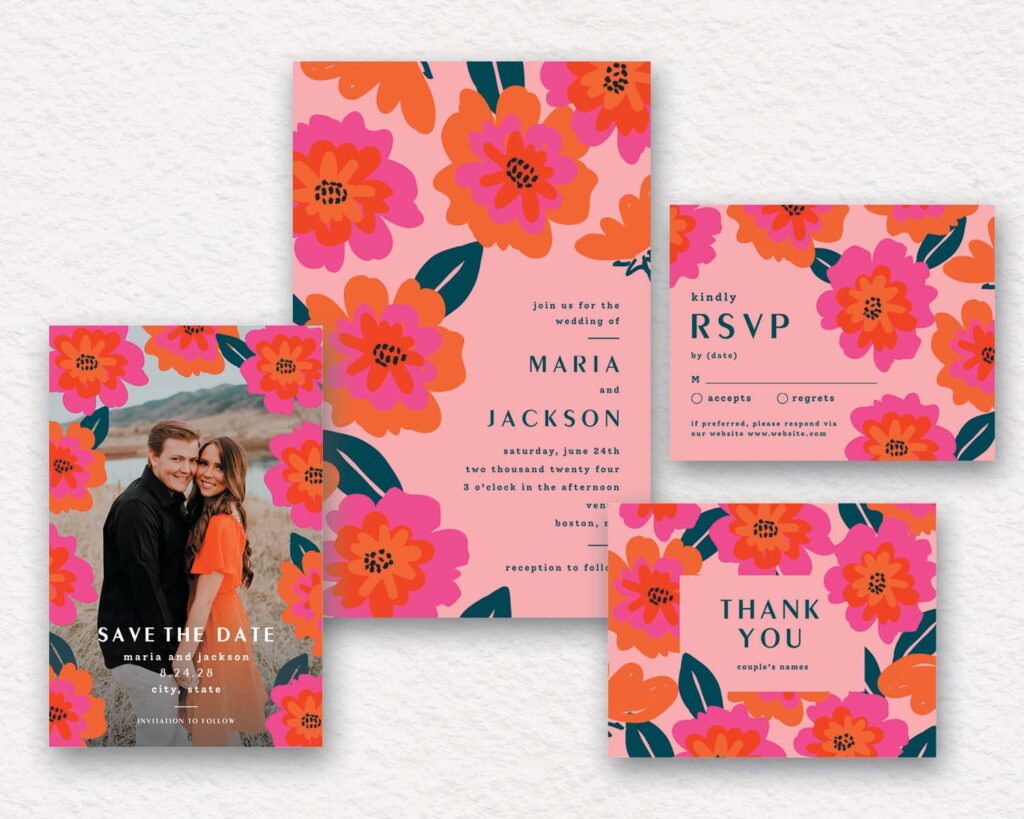
When to send wedding invitations
Wedding invitations are typically sent six to eight weeks before the wedding, but this time frame can vary depending on the length of the engagement, with more lead time recommended for destination weddings and peak-season celebrations.
How to handle RSVP deadlines and responses
RSVP deadlines are typically set a few weeks before the wedding to allow time for final planning. At this stage, the key consideration is clarity, as guests should immediately understand how and by when to respond. Send out RSVP cards or digital RSVPs via a QR code or wedding website to help simplify responses and reduce the need for follow-ups.
How to coordinate destination or multi-day weddings
For destination or multi-day weddings, use your invitation to introduce the main event and direct guests elsewhere, like a wedding website or a detailed printed itinerary, for extended travel and schedule details. This keeps your wedding invite clean while still setting clear expectations.
Designing your wedding invitation
Think about the overall vibe you want your wedding invitations to have. For example, you might want a traditional-looking invitation with serif fonts and lots of white and formal language. If you’re leaning toward a boho vibe, the invite might incorporate colorful illustrations, modern fonts and conversational language. Your wedding invite wording should feel like a natural extension of these visual choices.
Brainstorm your values and preferences with your partner if you’re not quite sure about your wedding invitation look. Work together to create a mood board and draw inspiration from the images you choose. This can also help you decide whether your wording should feel formal, relaxed, playful or modern.
Exercises to explore your wedding aesthetic:
- Imagine what guests will say about your wedding after it’s happened.
- How would you represent your relationship visually?
- If your wedding were a person, what would they be like?
Ask yourselves, what are some of the most memorable weddings you’ve attended and what made them memorable? Then consider how wording, design and layout worked together to create that experience.
What is the best tone for a wedding invitation?
Whether you choose formal or casual wording, a wedding invitation should have an upbeat, optimistic voice with a celebratory tone. It’s a wedding, after all!
The best wedding invite wording is the tone that accurately reflects the celebration you’re hosting. Whether that’s formal or casual, your invitation should feel welcoming, clear and aligned with both your design and guest experience.

If you’re still not sure about your wedding invite wording, share a draft with members of your wedding party to get their input. A second set of eyes can help spot unclear details or mismatched tone before printing.
Create and print the perfect wedding invitation with VistaPrint
Getting your wedding invitation wording right is part of designing the perfect invite. Then create a design using your chosen colors, fonts and other design elements that are uniquely you.
Wedding invite wording FAQs
How do you word a wedding invitation when the couple is hosting?
When the couple is hosting their own wedding, the wording can be simple and modern. Instead of naming hosts, invitations begin with the couple’s names, followed by important information. This approach works well for both formal and casual weddings.
How do you word a wedding invitation for divorced or blended families?
For divorced or blended families, clarity and sensitivity are key. List parents’ names on separate lines to avoid confusion and keep wording respectful. Invitations can also shift focus away from the hosts altogether and emphasize the celebration itself. What matters most is choosing wording that feels clear and comfortable for everyone involved.
Can you include a wedding website on the invitation without it feeling informal?
Yes, including a wedding website on your invitation is now widely accepted for both formal and casual weddings. Couples often list the website URL in a smaller font at the bottom of the invitation or on a separate details card. Use neutral language such as “For more information, please visit our wedding website.”
Should RSVP information be on the invitation or a separate card?
RSVP information can be included either on the main invitation or on a separate RSVP card, depending on your design and the amount of information you need to share. Separate RSVP cards are often used for more formal weddings or when meal choices are required, while digital RSVPs linked through a wedding website help simplify and encourage responses.


