
What is marketing collateral? Our marketing collateral definition goes beyond logos and printed materials to include the full range of brand assets – digital, physical and sales enablement – that help people recognize your business, trust it and feel confident choosing it.
From website design and logos to product packaging and reviews, marketing collateral shapes how people experience a brand at every stage of the buyer journey, not just at the point of sale. Think of a branded sticker on a takeaway cup or a downloadable guide you share after someone signs up. Both are examples of marketing collateral because they support the customer journey beyond a one-off promotion.
- Marketing collateral is all brand material designed to guide customers from awareness to conversion.
- Today’s marketing collateral includes both print and digital formats, from brochures and packaging to e-books, case studies and presentations.
- The most effective marketing collateral types work together across the buyer journey rather than existing as standalone pieces.
- Small businesses don’t need everything. Creating the right few assets first can deliver the biggest impact.

What is marketing collateral?
Marketing collateral is the branded, customer-facing content and design assets that a business uses to support marketing and sales. Using a practical marketing collateral definition, it’s the stuff that makes your brand feel real and recognizable across touchpoints – online, in person and after someone has shown interest.
Marketing collateral vs. marketing materials: what’s the difference?
Marketing collateral is usually built to support a specific stage of the buyer journey (for example, building trust in consideration or reducing friction at conversion). Marketing materials is a broader umbrella that can include collateral as well as more campaign-led items like ads, seasonal promotions and short-term announcements. In practice, small businesses use both together. But collateral is often what customers keep, refer back to or use to evaluate your brand.
Where does content marketing fit?
Content marketing focuses on attracting and educating an audience over time (think blog posts, videos, newsletters). Some content marketing can become marketing collateral when it’s packaged for decision-making or sales enablement. For example, turning a popular blog topic into a downloadable guide, checklist or e-book.
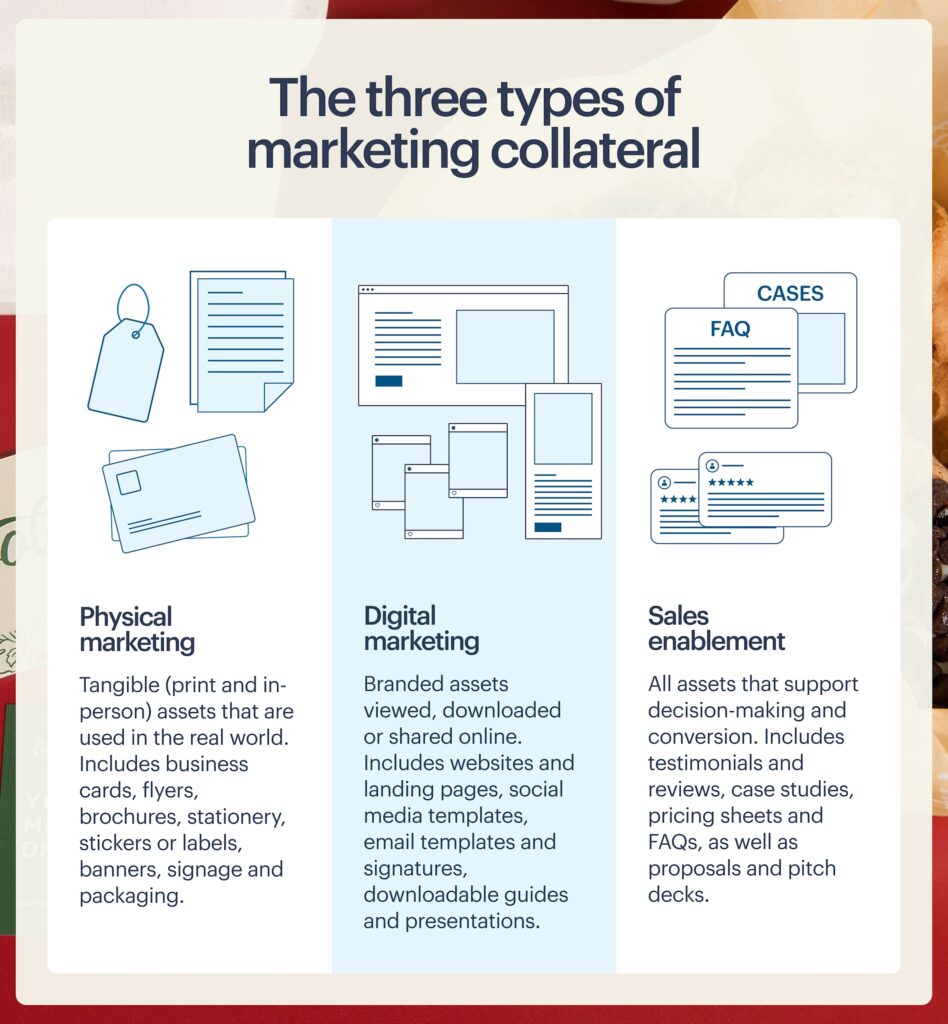
The 3 marketing collateral types
Rather than thinking about marketing collateral as a long checklist of individual items, it’s more useful to group it by format and intent. Different marketing collateral types play different roles depending on how customers interact with your business: online, in person or during the decision-making process.
The sections below break marketing collateral into three practical categories: physical, digital and sales enablement. Together, these show how each group supports the buyer journey.
Physical marketing collateral (print and in-person)
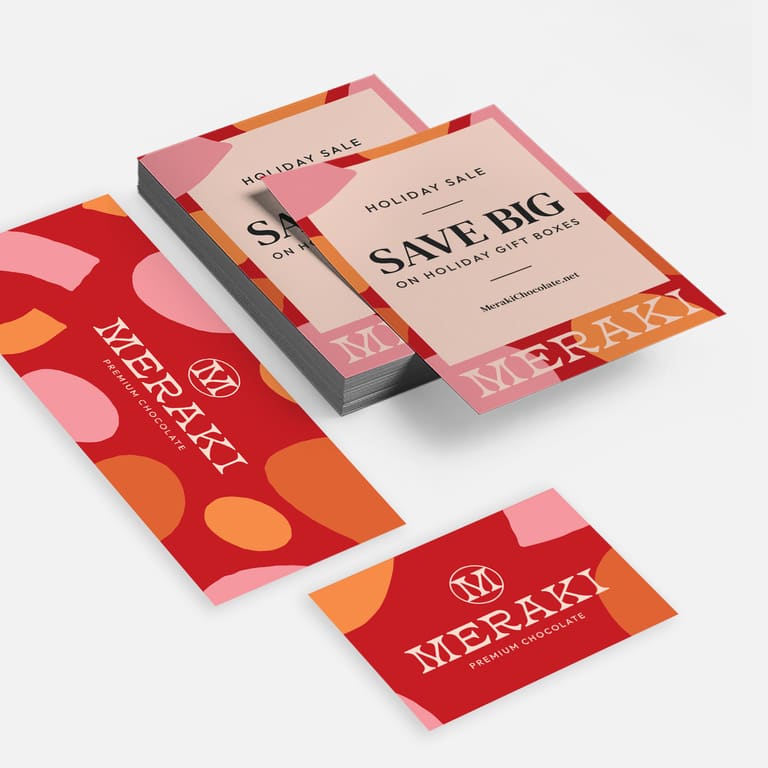
Physical marketing collateral includes anything tangible that makes your brand recognizable in the real world. These assets are especially valuable for local businesses, events, retail environments and any situation where customers interact with your brand face to face. This type of collateral often forms the first physical impression of your business and helps reinforce trust, professionalism and brand recall long after an interaction has ended.
Common examples of physical marketing collateral include:
- Business cards
- Flyers
- Brochures
- Booklets that introduce your services
- Branded stationery such as letterheads, envelopes
- Banners and signage
- Packaging including well-designed boxes, labels and inserts
- Stickers and labels
- Branded swag
Physical marketing collateral works best when it’s intentional. Rather than producing everything at once, small businesses often see better results by focusing on a few high-impact pieces that align with how and where customers encounter the brand. For more inspiration, read our guide to print marketing materials for small businesses.


Digital marketing collateral (web and shareable assets)
Digital marketing collateral covers branded assets that people view, download or share online. These assets are often the most visible and frequently used forms of collateral, especially for service-based or digital-first businesses.
This type of collateral helps customers learn, evaluate and stay engaged, particularly when they’re not ready to buy immediately. It also allows businesses to maintain a consistent brand presence across multiple channels without relying on one-off promotions.
Examples of digital marketing collateral include:
- Website pages and landing pages
- Social media profiles
- Reusable digital templates
- Branded email templates and signatures
- Downloadable assets such as guides, e-books and checklists
- Presentations and one-pagers used in pitches or proposals
- A brand book including your brand logo, colors, fonts and other design specs
Effective digital marketing collateral is designed to be reused, updated and shared across channels, making it a scalable way for small businesses to support marketing and sales without starting from scratch each time.


Sales enablement collateral (used to close and retain)
Sales enablement collateral is designed to support decisions, reduce any perceived risk and help a customer feel confident saying “yes.” It often appears later in the buyer journey, when someone is actively comparing options or considering a purchase.
This type of marketing collateral focuses less on awareness and more on proof, clarity and reassurance. It helps answer questions like “Is this right for me?” and “Can I trust this business?”
Common examples include:
- Testimonials and reviews that show real customer experiences
- Case studies that demonstrate how a specific problem was solved
- Product or service one-pagers
- Pricing sheets and FAQs
- Sales presentations and proposal decks
When used well, sales enablement collateral doesn’t feel overly salesy. Instead, it supports informed decision-making and helps customers move forward with confidence.


Why is marketing collateral important?
Marketing collateral matters because it creates consistency and confidence as people move from discovering you to choosing you. Instead of treating each asset as a standalone item, it helps to think of marketing collateral as a connected system that supports the buyer journey.
Without marketing collateral, your marketing materials can feel disconnected or incomplete. Imagine you run a dog-walking service and advertise with locally targeted social media ads. If people click through and can’t find a credible website or consistent social profile, the interest drops. If they do enquire but you have no business card, branded quote template or clear service overview, it can feel harder to trust you – even if you’re great at what you do.
If you’re a newer business owner or have limited resources, focus on a small set of high-impact marketing collateral types rather than trying to create everything at once. Well-designed, intentional assets will always outperform a large volume of inconsistent ones. Think about the kinds of marketing collateral that make the most sense for your brand and audience, for example branded gym water bottles if you’re a personal trainer.

Marketing collateral across the buyer journey
1. Awareness: Help people recognize you
At the awareness stage, marketing collateral helps people notice your brand and remember it later. This is where recognizable visuals do the heavy lifting: your logo, color palette, social templates, signage and even packaging. A consistent Instagram grid and a simple, on-brand banner at a local event make it easier for someone to connect the dots when they see you again online, for example.
2. Consideration: Build trust and reduce doubt
During consideration, marketing collateral helps potential customers evaluate you quickly and feel reassured they’re making a smart choice. This is where proof and clarity matter – testimonials, case studies, a polished website, a capability deck or a brochure that answers common questions. For example, a one-page services overview plus a short case study can show what you do and what results look like without sounding overly salesy.
3. Conversion: Make it easy to say “yes”
At conversion, marketing collateral removes friction and supports action. A focused landing page, branded email template, proposal deck or even a well-designed flyer with a QR code can guide someone to book, buy or enquire. You’re more likely to convert visitors into buyers with a landing page built for one service (with FAQs and a clear call to action) than a general homepage.
4. Retention: Keep customers
Just because you have made a sale doesn’t mean your customer is guaranteed to buy again. Use marketing collateral to reinforce your relationship with your customers like branded swag or thank-you cards. This helps customers feel more connected to your brand, so make the most of swag with an item they’re likely to use repeatedly. For example, a branded pen is more likely to be used by customers in a corporate environment.
| Buyer stage | Goal | Marketing collateral examples |
| Awareness | Build recognition | Logos, social media templates, stickers, banners |
| Consideration | Build trust | Case studies, testimonials, brochures, presentations |
| Conversion | Drive action | Landing pages, sales decks, packaging, email templates |
| Retention | Reinforce brand | Thank-you cards, onboarding guides, branded swag |

Learn more about marketing materials for your small business with our article on 14 essential marketing materials.
Tips for creating marketing collateral
The following tips can help you design marketing collateral that’s both aesthetically pleasing and connects with your target audience effectively.
Play with trends
Let current marketing and design trends inspire you, but adapt them to your brand identity rather than following them blindly.
Marketing collateral trends for 2026
These are some of the most recent design trends for marketing collateral:
- Interactive digital collateral, such as clickable PDFs and dynamic presentations.
- Personalization at scale, powered by templates and data-driven customization.
- Stronger brand consistency across remote and distributed teams.
- Hybrid print-digital experiences, like QR-enabled brochures and packaging.

Create design variations
Although consistency is key when it comes to branding, making minor changes actually strengthens brand recognition. Remember that consistency doesn’t mean repetition. Strategic variations can strengthen recognition across different channels. So instead of using the same version of your logo on every piece of marketing collateral, use variations in color and design.
The same goes for your color palette. Say yours consists of three colors, combine them in different ways through various pieces of marketing collateral so people come to associate the combination with your brand.
Need some design inspiration? Consider the many ways you can use a sticker to boost branded collateral immediately. Check out our unique sticker ideas to get started.
Ask for feedback
Your audience is one of your best assets to determine what works when it comes to marketing collateral. Ask them directly for their feedback on proposed designs and in fun ways, like through social media contests, polls and giveaways. Use customer feedback and engagement metrics to refine and improve your collateral over time.

Measuring and managing marketing collateral
To understand whether your marketing collateral is working, track metrics tied to its purpose. For example, measure downloads for digital guides, engagement for social templates, conversion rates for landing pages or recall and trust through customer feedback.
To successfully manage and maintain consistency with your marketing collateral, use shared folders, clear naming conventions and brand guidelines. This ensures your teams are always using the most up-to-date assets across channels.

Design and print your marketing collateral with VistaPrint
Strong marketing collateral helps your business look credible, consistent and trustworthy at every customer touchpoint. Whether it’s a brochure, website, sticker or presentation, each piece should support your brand’s story and business goals.
Remember, engaging design and brand cohesion are key when designing marketing collateral. So the branded collateral you send out into the world, both digital and physical, needs to present your brand as attractively, professionally and clearly as possible.
Marketing collateral FAQs
What is marketing collateral in simple terms?
Marketing collateral is any branded asset, both print and digital, that helps promote, support or reinforce a business and its brand.
What are examples of marketing collateral?
Examples include logos, business cards, brochures, case studies, websites, social media templates, packaging and presentations.
What is the difference between marketing collateral and marketing materials?
Marketing materials cover a wider range of assets from promotional to building recognition, while marketing collateral supports a customer along the buyer journey. Marketing collateral is a type of marketing material.
Why is marketing collateral important for small businesses
It helps build credibility, guide customers through the buying process and create consistent brand experiences.
Is digital content considered marketing collateral?
Yes, digital assets like e-books, landing pages, email templates and presentations are all considered marketing collateral.