Conference budgets rarely go off track because of one dramatic mistake. More often, it’s a string of smaller costs, late decisions and moving headcounts that slowly push the numbers out.
These types of budgets work best as an ongoing planning process rather than a spreadsheet you create once and revisit just before the event. Costs can change as registrations grow, supplier quotes come in and deadlines get closer, so building a clear 12-month framework helps you make those decisions with fewer surprises.
This guide covers the full conference budgeting cycle for a business-to-business (B2B) conference, including fixed and variable costs, a year-round planning timeline, attendee cost-per-head calculations and print procurement. You’ll also learn how to build in contingency, manage financial risk and compare your forecast with actual spend after the event.
- Separate fixed conference costs from variable attendee expenses so you can see which parts of the budget change as registration grows.
- Build your budget and procurement schedule together, using a 12-month timeline to plan major commitments and print deadlines.
- Track cost per attendee as your conference scales so you can compare different registration scenarios and estimate break-even points.
- Keep a contingency reserve for unexpected costs such as price changes, contract penalties, shipping or emergency reprints.
- Reconcile your forecast against actual invoices after the event so the next planning cycle starts with better data.
What is conference budgeting? Core financial framework and cost structures
Conference budgeting is the process of forecasting, organizing and tracking the costs involved in running a conference, then comparing those costs with expected income from registrations, sponsorships or other funding.
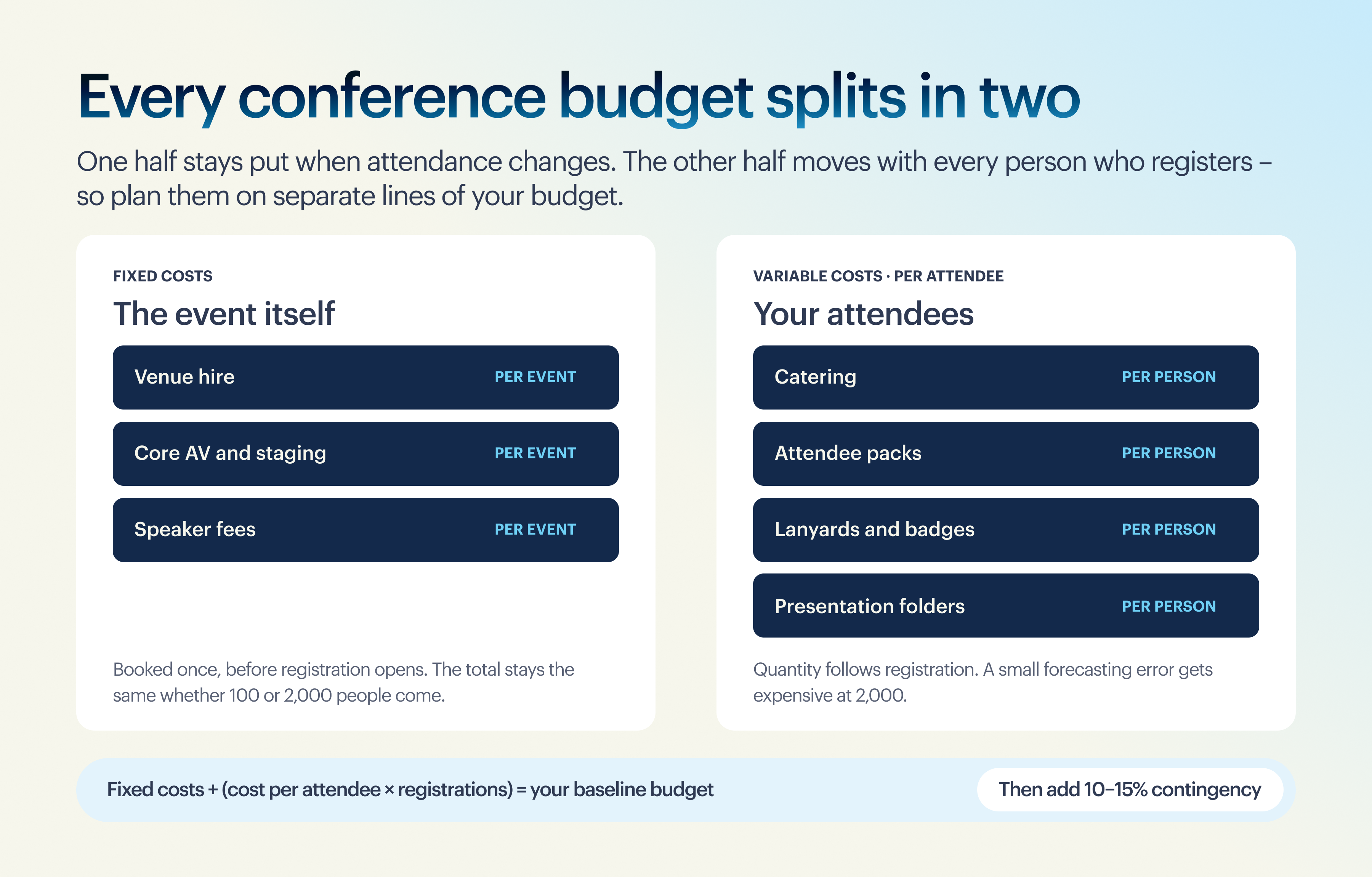
Start by separating fixed costs from variable costs. Fixed costs stay broadly the same regardless of attendee numbers and might include venue hire, core AV setup or speaker fees. Identifying these early gives you a clearer view of the baseline cost of running the event before per-attendee expenses are added.
Variable costs change as attendance rises or falls. These can include catering, attendee packs, custom lanyards, presentation folders and other per-person materials. Tracking these separately makes it easier to calculate cost per attendee and test different registration scenarios.
A percentage breakdown can help you sketch out an initial budget before supplier quotes arrive, but it should be treated as a planning example rather than a benchmark. One starting point could look like this:
- Venue and catering: 50%
- AV and production: 20%
- Marketing and print collateral: 15%
- On-site staffing: 10%
- Administration: 5%
Keep contingency separate from those planned costs so you can see how much funding you need above the operating budget.
Print collateral is another variable cost worth tracking separately because quantities often depend on attendance. Estimating volumes early gives you more time to compare options, request samples and plan orders before the event enters its busiest production period.
Want to put the framework into practice? Use the downloadable conference budgeting template to track fixed costs, variable expenses, expected income and contingency in one place. Download the conference budgeting template
The 12-month annual conference planning timeline
A 12-month timeline helps you spread major decisions and financial commitments across the year instead of concentrating them in the final few months. It also gives you clearer points for reviewing attendance forecasts, supplier costs and procurement deadlines as the event gets closer.
Q1 (Months 12–10): Strategic approval and venue commitments
Start by confirming the event objective, target attendance and overall budget. This is also the stage to shortlist venues, review contract terms and plan for major deposits. If hotel room blocks are part of the event, check the attrition terms so you understand the financial impact if bookings fall below the agreed level.
Q2 (Months 9–7): Programming, speakers and sponsorship
As the program takes shape, confirm speaker agreements, develop sponsorship materials and open registration when appropriate. Early registration data can give you a useful first indication of demand, helping you revisit attendance forecasts and adjust later spending decisions.
Q3 (Months 6–4): Marketing and print proofing
By this stage, you should have a clearer picture of likely attendance and can start refining quantities for printed materials. Review artwork, request samples or proofs where useful and confirm what signage, folders, badges and other collateral will be needed. This is also a good point to check production and delivery timelines before placing larger orders.
Q4 (Months 3–0): Production lock and event delivery
In the final months, shift the focus toward confirming quantities, delivery dates and on-site logistics. Finalize catering numbers and banquet event orders where required, schedule print deliveries with enough buffer for any issues and confirm when suppliers can access the venue. Before opening, check that staging, AV equipment and directional signage are in place and ready to use.
Downloadable 12-month conference planning timeline
Line-item conference budget breakdown by delegate tier
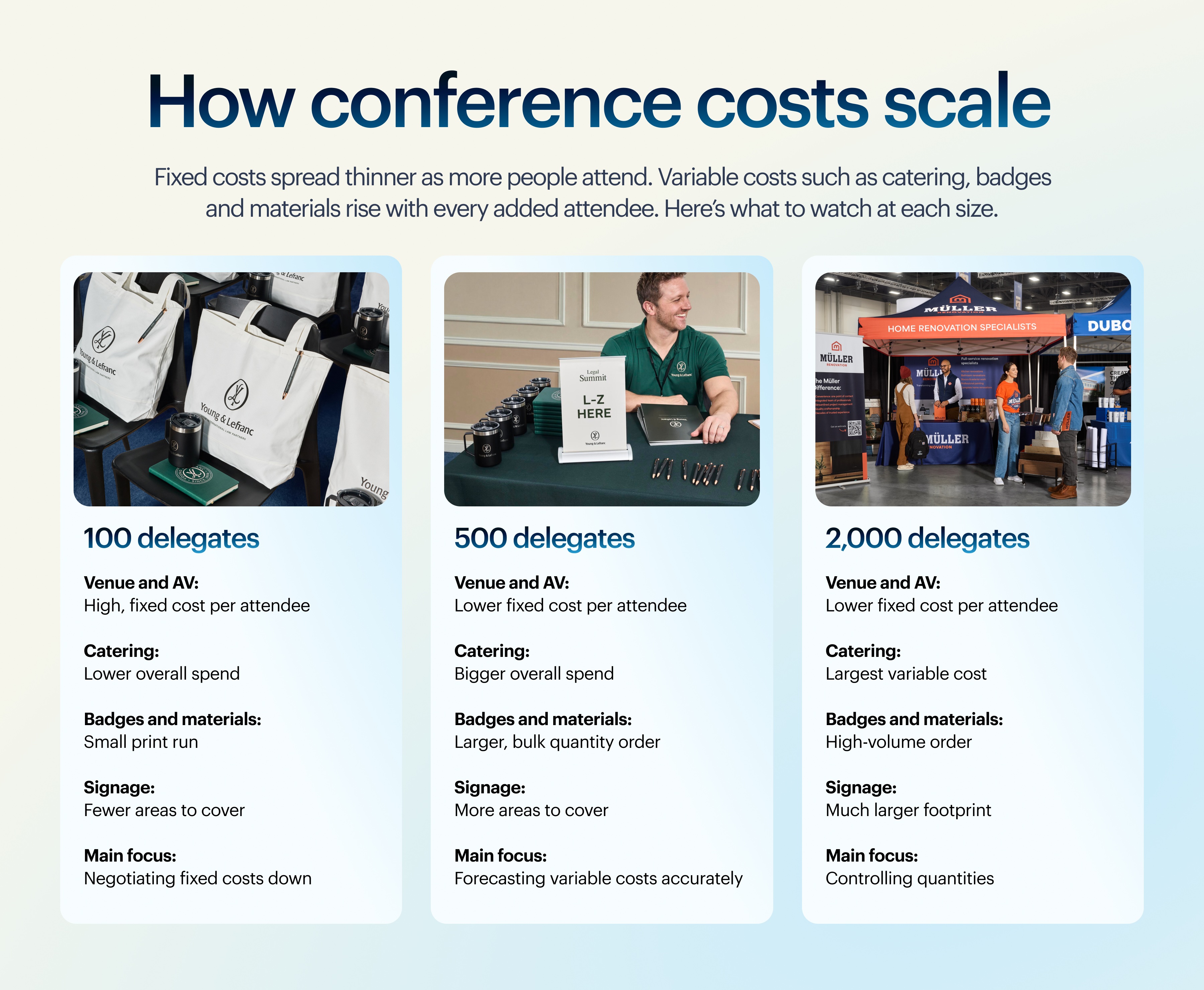
Conference costs behave differently as attendance grows. Fixed costs are spread across more delegates, while variable expenses such as catering, badges and attendee materials rise with headcount. Comparing different attendance scenarios helps you understand how those changes affect cost per person and your break-even point.
100 delegates
At around 100 delegates, fixed costs such as venue hire and core AV are spread across a relatively small audience, which can push up the cost per attendee. Variable costs may be easier to control at this scale, but you still need to account carefully for catering, registration materials and attendee packs.
500 delegates
At around 500 delegates, fixed costs are spread across a larger group, which can reduce the cost per attendee. At the same time, variable costs become a much bigger part of the overall budget, so registration forecasts matter more when planning catering, printed materials and attendee kits.
2,000 delegates
At around 2,000 delegates, even small per-person changes can have a large effect on total spend. Fixed costs may be spread more widely, but variable costs such as catering, badging, signage and attendee materials need tighter quantity control because small forecasting errors are multiplied across a much larger audience.

To estimate your break-even attendance, first subtract projected sponsorship or other guaranteed income from your fixed event costs. Then divide the remaining amount by the contribution each attendee makes after variable per-person costs are removed:
Break-even attendees = (fixed costs − other event income) ÷ (ticket price − variable cost per attendee)
This gives you an estimated attendance level needed to cover your costs.
You can use the same approach to track attendee materials:
Collateral cost per attendee = total collateral spend ÷ number of attendees
Tracking this figure as registration changes makes it easier to compare quantities and keep per-person materials within budget.
| Cost area | 100 delegates | 500 delegates | 2,000 delegates |
|---|---|---|---|
| Venue and AV | High per attendee | Lower per attendee | Lower per attendee |
| Catering | Smaller overall spend | Bigger overall spend | Major variable cost |
| Badges and attendee materials | Lower total quantity | Larger bulk quantity | High-volume order |
| Signage and wayfinding | Fewer needed | More areas to cover | Much larger venue footprint |
| Main budget focus | Managing fixed costs | Keeping forecasts accurate | Controlling quantities |
Print and physical collateral procurement: Unit economics and lead times
Print and physical collateral should be planned alongside the rest of the conference budget, not left until the final weeks. For a large conference, eight to 12 weeks before the event can be a useful planning window for starting final print procurement, giving you time for proofs, changes and delivery. Check production and shipping times for each product before setting your final order deadline.
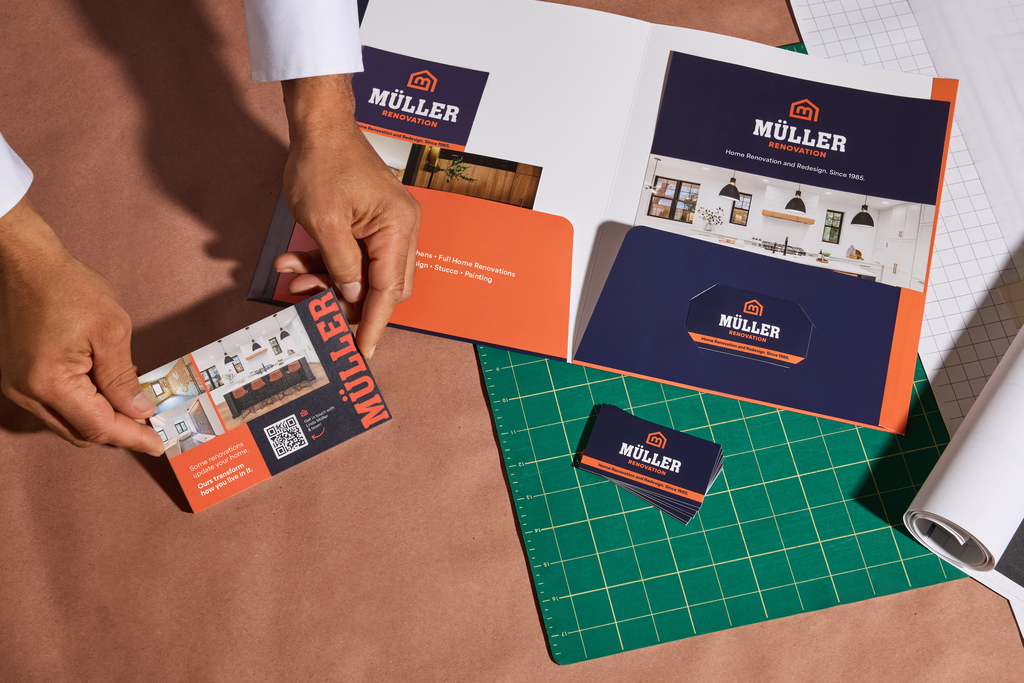
For attendee welcome packs or sponsor materials, presentation folders can help keep agendas, brochures and other documents together. VistaPrint offers matte and glossy stock options, customizable pockets and an included business card slot, so factor the folder specification and quantity into your per-attendee budget early.

Badges and custom lanyards are another per-attendee cost that scales with registration. VistaPrint offers a range of lanyard and badge-holder styles, including polyester options and breakaway designs, so choose the format that suits the event and include the full quantity in your variable-cost forecast.
Signage should be budgeted against the venue layout, so you know how many entrances, junctions and presentation areas need coverage. VistaPrint retractable banners come with aluminum cassette options and a choice of vinyl, PVC-free vinyl or polyester banner materials, making them a practical option for directional or branded displays.

“Finding the right suppliers and manufacturers comes with its fair share of challenges, so thorough research and comparison are essential before committing to one. Be sure to factor in shipping lead times, order samples, and negotiate bulk pricing to ensure your materials arrive when needed without inflating expenses.” – Ashleigh King, Owner of Nala&Co.
Build a small quantity buffer into attendee materials where it makes sense, especially for badges, folders and other items tied directly to registration numbers.
For larger print runs, request samples or proofs where they’re available before approving the full order. This gives you a chance to check the material, finish and overall appearance before committing to a larger quantity.
Managing financial risk: Inflation buffers, venue attrition and freight mitigation
Even a well-planned conference budget needs room for costs that change or appear unexpectedly. Contract penalties, supplier price changes and shipping problems can all affect the final spend, so build contingency into the budget from the start rather than treating it as an afterthought.
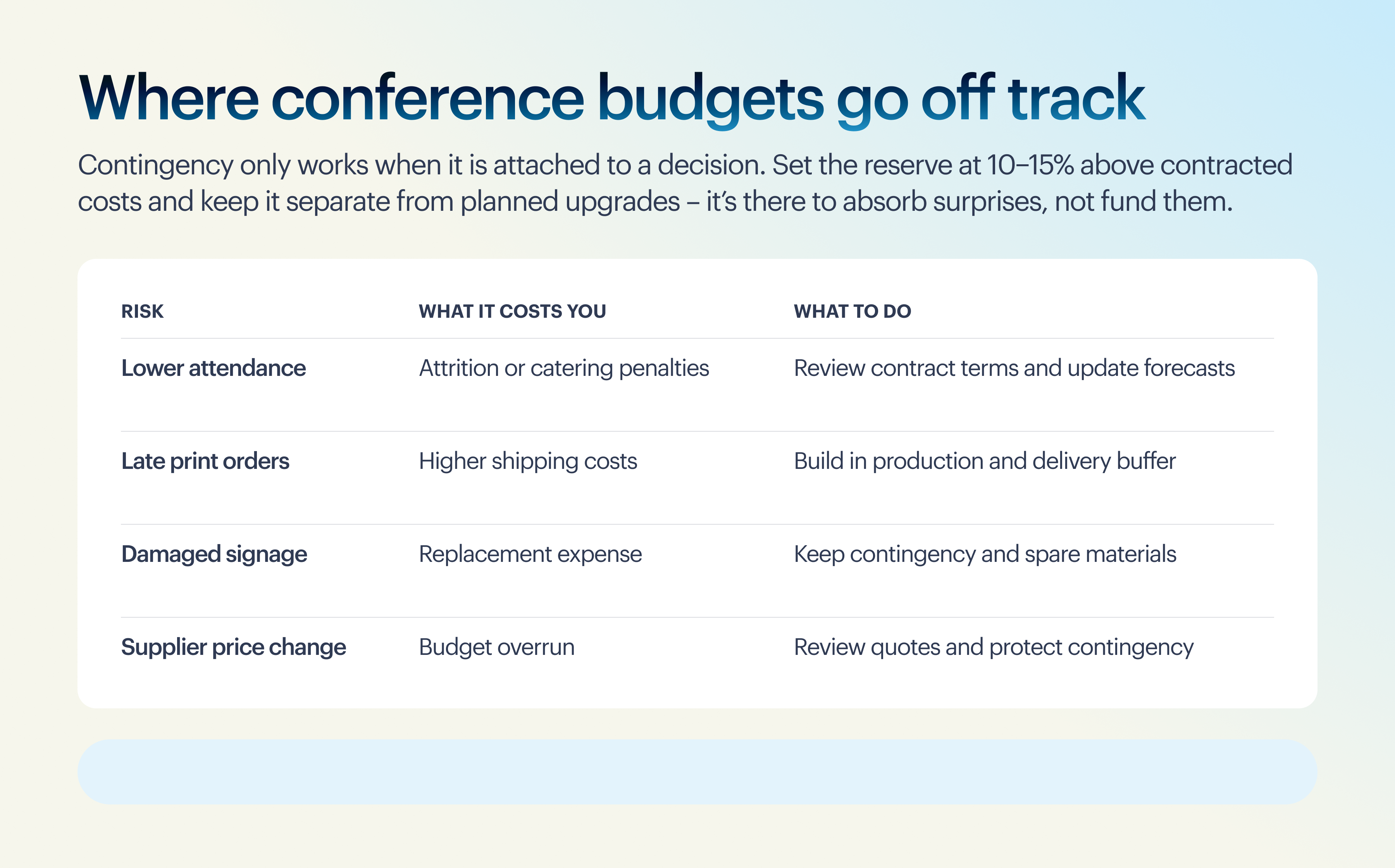
A contingency reserve gives you room to absorb unexpected costs without cutting into planned activity elsewhere. As a starting point, consider setting aside around 10%–15% above contracted costs, then keep that money separate from planned upgrades or optional extras.
Review venue contracts carefully for attrition clauses, room-block commitments and food and beverage minimums. If attendance comes in below forecast, those terms can leave you paying for unused rooms or catering commitments. Track registration closely as the event approaches and adjust guarantees where your contract allows.
Shipping becomes more expensive and less flexible when print orders are left too close to the event. Confirm production and delivery timelines early, leave a buffer for delays and make sure you know where materials should be sent before the venue load-in period begins.

It also helps to agree in advance who can approve unexpected spend on the day. Keep a short contingency checklist covering issues such as extra registrations, damaged signage, replacement materials or unexpected technical costs so the team knows what to do and who can sign off the expense.
| Risk | Possible impact | What to do |
|---|---|---|
| Lower attendance | Attrition or catering penalties | Review contract terms and update forecasts |
| Late print orders | Higher shipping costs | Build in production and delivery buffer |
| Damaged signage | Replacement expense | Keep contingency and spare materials |
| Supplier price change | Budget overrun | Review quotes and protect contingency |
Close out your conference budget and plan the next cycle
Your conference budget shouldn’t end when the event does. Closing out the numbers while the details are still fresh gives you a more accurate view of what the event actually cost and a stronger starting point for next year.
Compare your original budget with final supplier invoices and note where actual spend differed from the forecast. Look for the reasons behind those differences, whether that was attendance, scope changes, supplier pricing or unexpected costs. Recording those variances now gives you useful benchmarks for future planning.
Carry the final cost-per-attendee figures and key lessons into the next planning cycle. Using your own event data makes future budgets easier to build and gives you a better basis for estimating quantities, supplier costs and contingency.
Conference budgeting FAQs
What should be included in a conference budget?
A conference budget should cover venue and catering, AV and production, staffing, marketing, print collateral, attendee materials, administration and contingency. It should also separate fixed costs from expenses that change with attendance.
How often should you update a conference budget?
Update the budget whenever a major cost, attendance forecast or supplier commitment changes. Regular reviews throughout the planning cycle make it easier to spot overspend early rather than discovering it after the event.
How do sponsorships affect a conference budget?
Sponsorship income can reduce the amount that needs to be covered by ticket sales or organizational funding. Keep projected sponsorship revenue separate from confirmed income so your break-even calculations aren’t based on money that hasn’t been secured yet.
What is the best way to track conference budget changes?
Keep the original forecast alongside the latest expected spend and final actual cost for each line item. Adding a short note explaining major changes makes post-event reconciliation much more useful when you start planning the next conference.
Should conference budgets include taxes and service fees?
Yes, where they apply. Supplier quotes may not always include taxes, service charges, delivery fees or other additional costs, so check what is included before adding the figure to your working budget.