Some business cards need to handle rain, wet hands, mud and humidity. Others simply need to look a little less ordinary. This waterproof business card guide covers both.
We’ll compare the most common waterproof business card materials and show where each performs best. You’ll also learn how to choose the right card for your working conditions, what recyclability and durability claims really mean and how to design artwork that works on plastic.
- Waterproof business cards use non-absorbent materials that resist damage from direct or repeated water exposure.
- They’re ideal for hands-on and outdoor businesses, especially in wet, humid or coastal environments.
- Common materials include PP synthetic paper, PET and PVC, each with different strengths, feel and print requirements.
- Choose based on workplace hazards, flexibility, appearance and verified material specifications.
- When designing for plastic, prioritize legibility, follow print requirements and account for the opacity of white, clear or frosted stock.
What are waterproof business cards?
Waterproof business cards are cards designed to withstand water without absorbing moisture, swelling, softening or disintegrating. Unlike conventional paper cards, they’re typically made from non-absorbent waterproof card stock, such as plastic or synthetic material.
That doesn’t mean every card marketed as “durable” offers the same protection:
- Waterproof vs. water-resistant business cards: Water-resistant cards handle occasional splashes or damp hands. Waterproof cards withstand direct or repeated contact with water, making them better for jobs where getting wet is routine.
- Waterproof vs. tear-proof business cards: These protect against different hazards. Tear-resistant business cards withstand ripping and rough handling, while waterproof cards resist water. Some materials do both, but one property doesn’t guarantee the other.
Are laminated paper business cards waterproof?
Not necessarily. Lamination adds a protective plastic film that helps paper cards resist splashes. However, the paper core can remain exposed at the cut edges. Because traditional cardstock is made from absorbent wood-pulp fibers, water that reaches the core can cause warping, peeling or separation from the laminate.
Plastic and synthetic cards have no paper core, so their water resistance comes primarily from the substrate itself.
Who benefits from waterproof business cards?
Waterproof business cards are a practical choice when working conditions are tough on conventional paper:
- Landscapers, gardeners and construction trades: Rain, soil, damp gloves and crowded toolboxes put cards through plenty of wear.
- Plumbers, pool technicians and pressure-washing businesses: Direct contact with water is often unavoidable.
- Marine businesses, fishing charters, surf schools and scuba instructors: Salt spray, wet equipment and coastal air create near-constant moisture exposure.
- Mechanics and mobile technicians: Grease, grime and rough handling call for a more durable material.
- Food trucks, caterers and hospitality businesses: Spills, wet counters and frequent handling increase the risk of stains and damage.
- Outdoor guides, instructors and event vendors: Outdoor business cards need to cope with rain, sweat and long days outside.
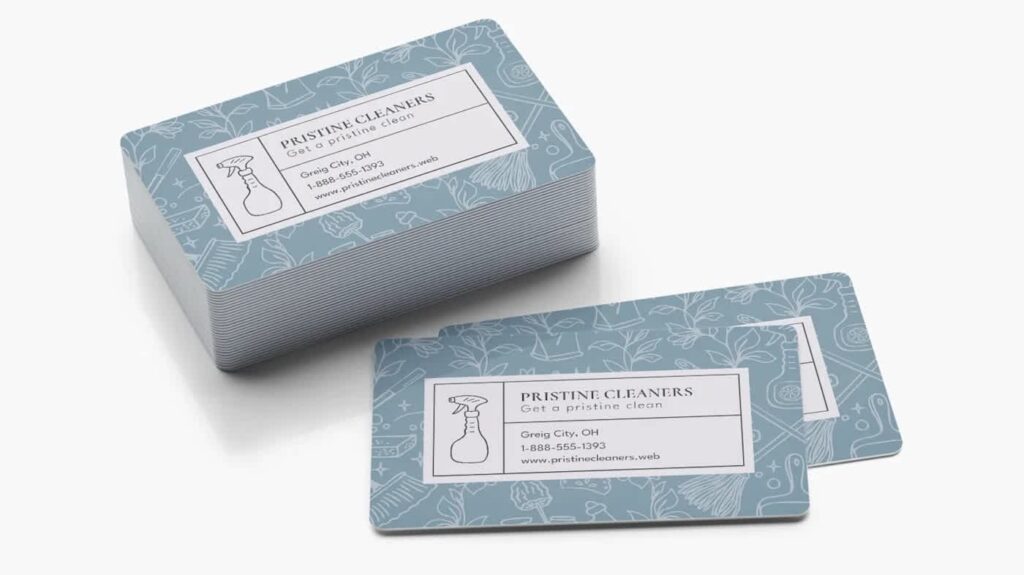
- Pet groomers and mobile cleaners: Splashes and damp work areas come with the territory.
Location matters, too. In humid and coastal climates, cards can absorb moisture during everyday storage and handling without ever getting directly wet. A non-absorbent stock helps prevent the softening and warping that paper can develop in these conditions.
What is the best waterproof business card material?
There’s no single “best” waterproof business card material. Options include flexible synthetic paper business cards, often made from PP, as well as PET and firmer PVC, commonly used for vinyl business cards. Each differs in durability, feel, print requirements and environmental impact.
Waterproof business card material comparison
| Material | Water protection | Feel | Key strengths | Key limitations | Print and design considerations |
| Polypropylene (PP) synthetic paper | Waterproof | Thin, lightweight and flexible | Tear-resistantResistant to many oils and chemicalsPVC-free | Less rigid than plasticMay crease, depending on thickness | Its smooth, non-absorbent surface requires compatible inks and printing methods |
| Polyester (PET) | Waterproof | Smooth, flexible to semi-rigid | Strong tear resistanceResists scratches and frequent handlingHolds its shape well | Less paper-like than PP Durability and feel vary by thickness | Requires inks or surface coatings designed for the material to prevent smudging or poor print adhesion |
| PVC plastic | Waterproof | Firm, smooth and plastic-like | Very difficult to tearHighly durableAvailable in opaque, clear and frosted options | Less flexible than PPHas a distinctly plastic feelLimited recycling options in many areas | Works well for clear plastic business cards and frosted plastic business cards; white ink may be needed beneath text or graphics on transparent stock |
Are waterproof business cards recyclable?
Sometimes. Waterproofing doesn’t automatically rule out recycling, but the answer depends on what the card is made from:
- PP: Technically recyclable, although facilities may not accept small synthetic cards.
- PET: Widely recyclable as a material, but printed cards aren’t necessarily accepted everywhere.
- PVC: More difficult to recycle and rarely accepted through curbside programs.
- Laminated paper: Paper bonded to plastic film is difficult to separate and recycle.
Printing can complicate things further. Inks, adhesives, coatings and durable business card finishes may affect whether a card can be processed.
Before tossing a card into the recycling bin, check the actual substrate and your local rules rather than relying on a recycling symbol or a generic “plastic” label.
And if sustainability matters when ordering, consider lifespan too. A card that holds up longer may need replacing less often.
How to choose the right waterproof business card material
The toughest card on paper isn’t automatically the best one for your business. The useful question is what combination of durability, flexibility, appearance, print performance and environmental considerations fits the way you’ll actually use it.
1. Match the material to the hazards
Start with the conditions your cards will face most often:
| Working condition | Main threat | What to prioritize | Material direction |
| Rain and wet hands | Water + tearing while wet | Waterproofing + tear resistance | Waterproof-rated PP, PET or PVC |
| Mud and soil | Moisture + dirt + wiping | Waterproofing + cleanable surface | PP, PET or PVC; verify cleanability |
| Poolside and watersports | Repeated splashing and soaking | Fully waterproof substrate | Waterproof-rated PP, PET or PVC |
| Coastal and marine environments | Humidity + saltwater + spray | Waterproofing + print durability | Verify substrate and print system for marine exposure |
| Garage and workshop use | Grease + dirt + abrasion | Surface durability + cleanability | PP, PET or PVC; verify oil resistance separately |
| High humidity | Persistent atmospheric moisture | Non-absorbent substrate | PP, PET or PVC |
| Heavy pocket or toolbox use | Bending + rubbing + repeated handling | Tear resistance + suitable rigidity | Flexible PP, PET or PVC, or rigid PVC depending on use |
| Cleaning and disinfecting | Water + cleaning chemicals | Chemical resistance | Check the manufacturer’s chemical-resistance specifications |
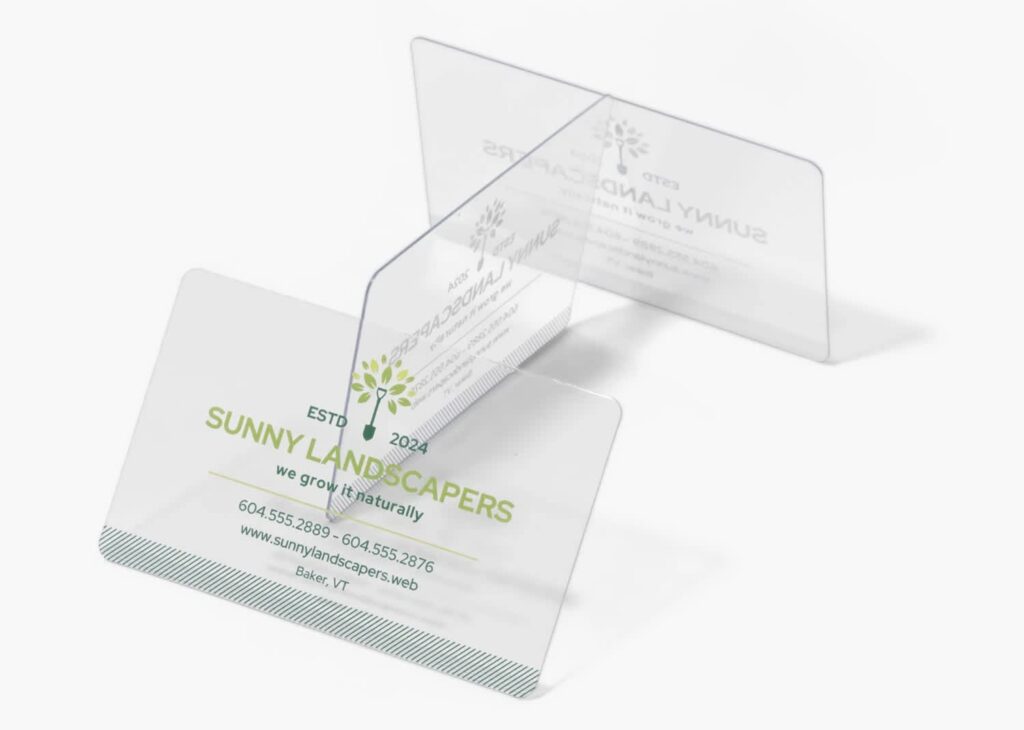
Waterproof doesn’t mean resistant to everything! If your cards may encounter oil, fuel, alcohol, disinfectant or solvents, check the manufacturer’s resistance specifications rather than assuming a waterproof card is also a stain-proof business card.
2. Consider how much flexibility you need
Plastic cards generally come in two formats:
- Flexible plastic cards: Often around 0.02 inches thick, these bend more easily and work well for cards carried in pockets, wallets or work bags.
- Rigid plastic cards: Often around 0.03 inches thick, these resist bending and have a sturdier, credit-card-like feel.
As a rule of thumb, choose flexible for easy everyday carrying and rigid for maximum structure and a more premium card-like feel.
3. Choose between white, clear and frosted plastic business cards
The material can do some of the visual work before you add a logo, color or type.
White plastic business cards
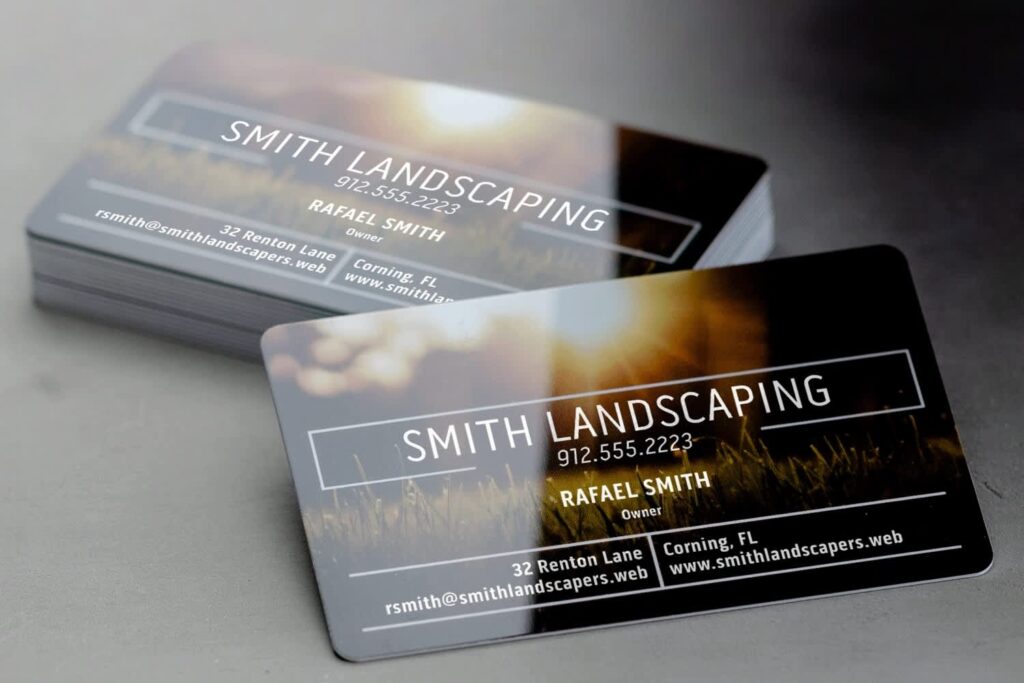
White plastic business cards give artwork an opaque, neutral base. Colors stay easy to control, contrast is straightforward and photographs reproduce without the background showing through.
Clear plastic business cards
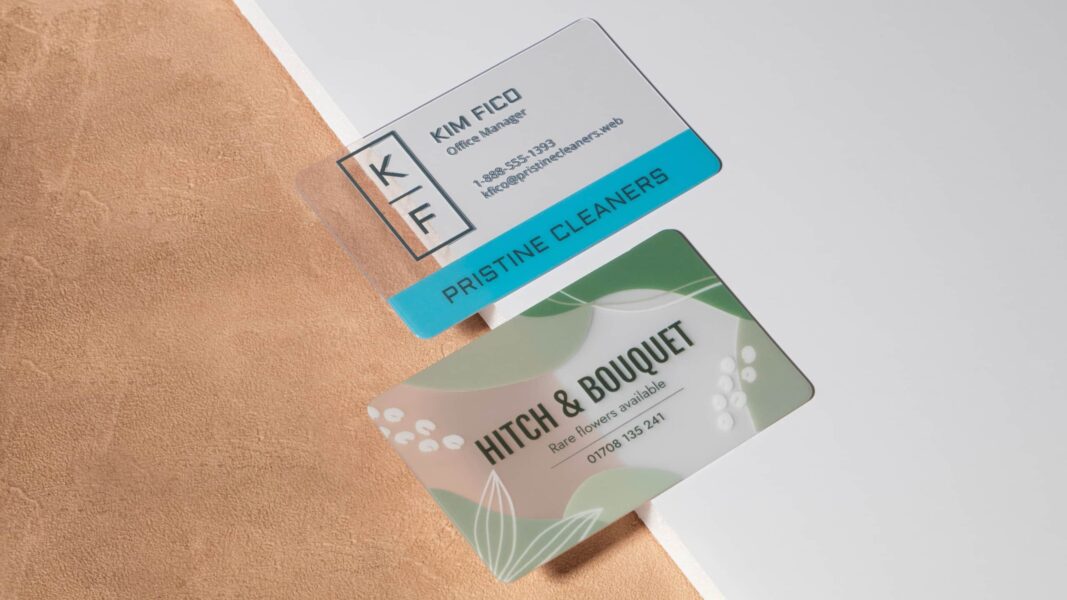
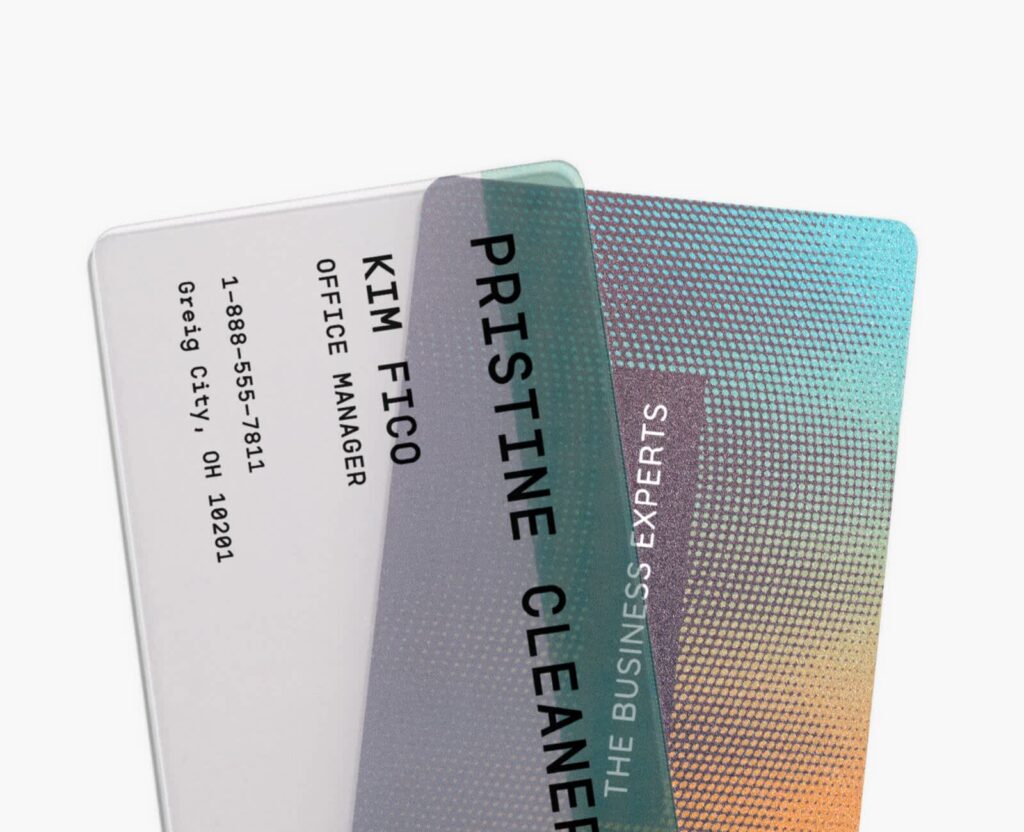
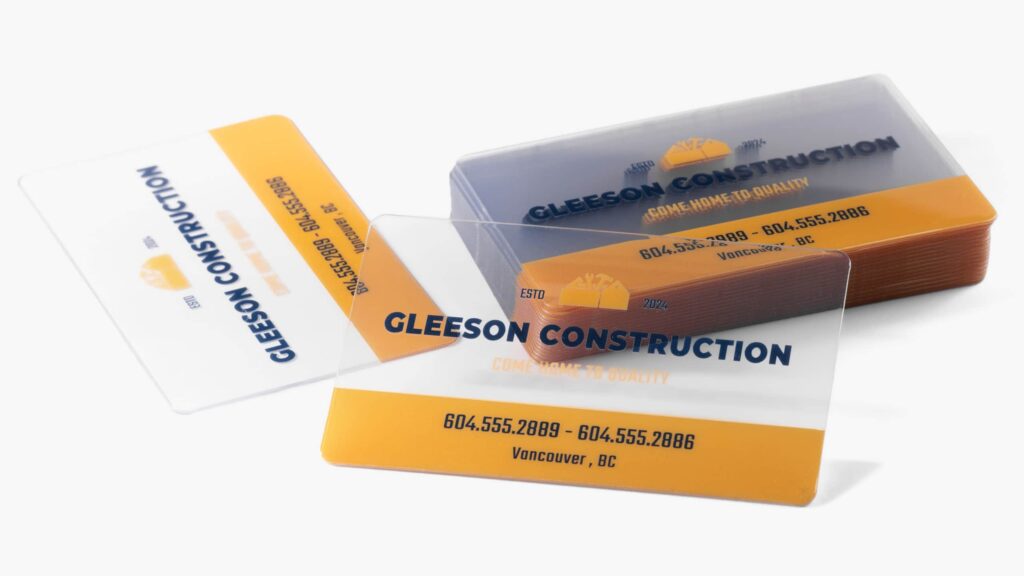
Transparency is the defining feature of clear plastic business cards, so every unprinted area remains see-through. That changes how colors, text and overlapping elements behave.
Frosted plastic business cards
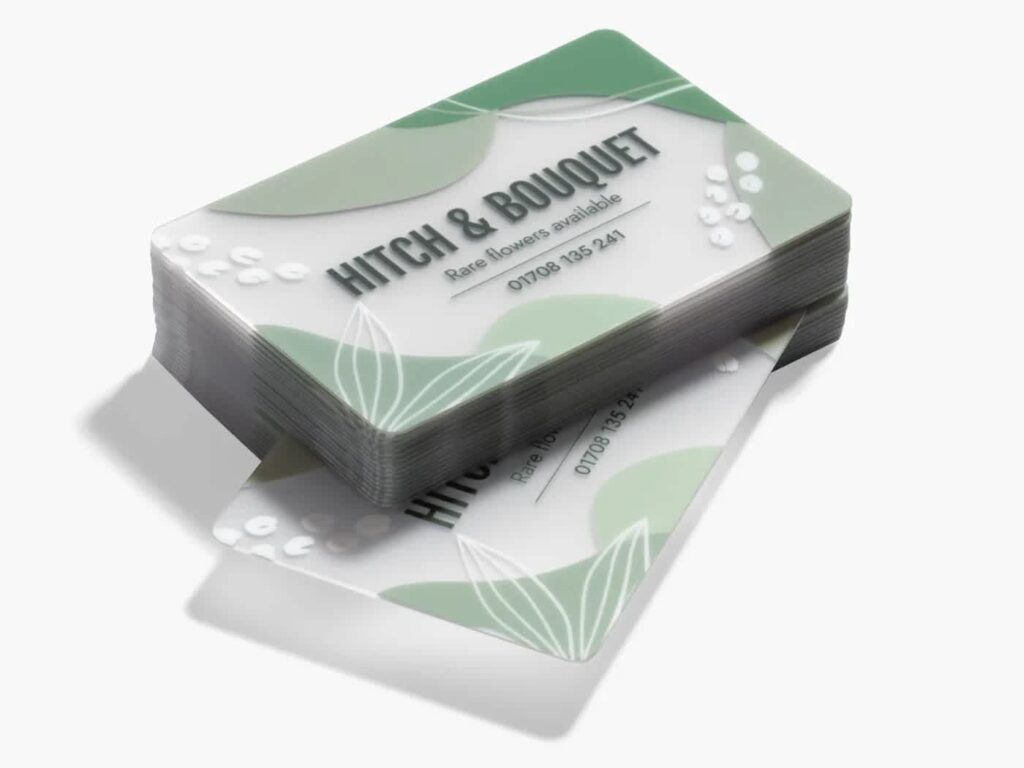
Frosted plastic business cards let light through but blur what sits behind them. The result is less transparent than clear stock, with a muted background that can make text and graphics easier to separate visually.
| Choose… | When you want… |
| White | Maximum flexibility with color and contrast |
| Clear | Transparency to play a major role in the design |
| Frosted | A softer, semi-transparent effect |
4. Check that “waterproof” actually means waterproof
Product names can be vague, so head straight to the specifications. Labels like “premium,” “durable,” “coated,” “synthetic,” “plastic-like” or “outdoor” don’t necessarily mean waterproof.
Look for a clear waterproof claim and check what it covers: the substrate, printed surface or finished card. If you only see “water-resistant,” don’t count on the card surviving repeated soaking or immersion.
For demanding environments, check whether the manufacturer provides separate resistance ratings for the hazards your cards will encounter.
Plastic card printing guide: Design rules for waterproof business cards
Once you’ve settled on a material, the next job is making sure your design works on it. Plastic and synthetic stocks come with different print requirements than conventional cardstock, and a few small artwork decisions can make a noticeable difference in the finished card.
Design for a non-porous surface
Paper absorbs ink into its fibers; plastic doesn’t. That makes the substrate, ink and printing process closely connected.
While you don’t need to choose the printing technology yourself when ordering from a commercial printer, you do need to design within its limits:
- Use the template for the exact plastic card and follow its file format, color mode and resolution requirements.
- Check for material-specific artwork rules before repurposing a design created for paper.
- Order a proof or small test run when color accuracy is particularly important.
Keep typography and fine details print-friendly
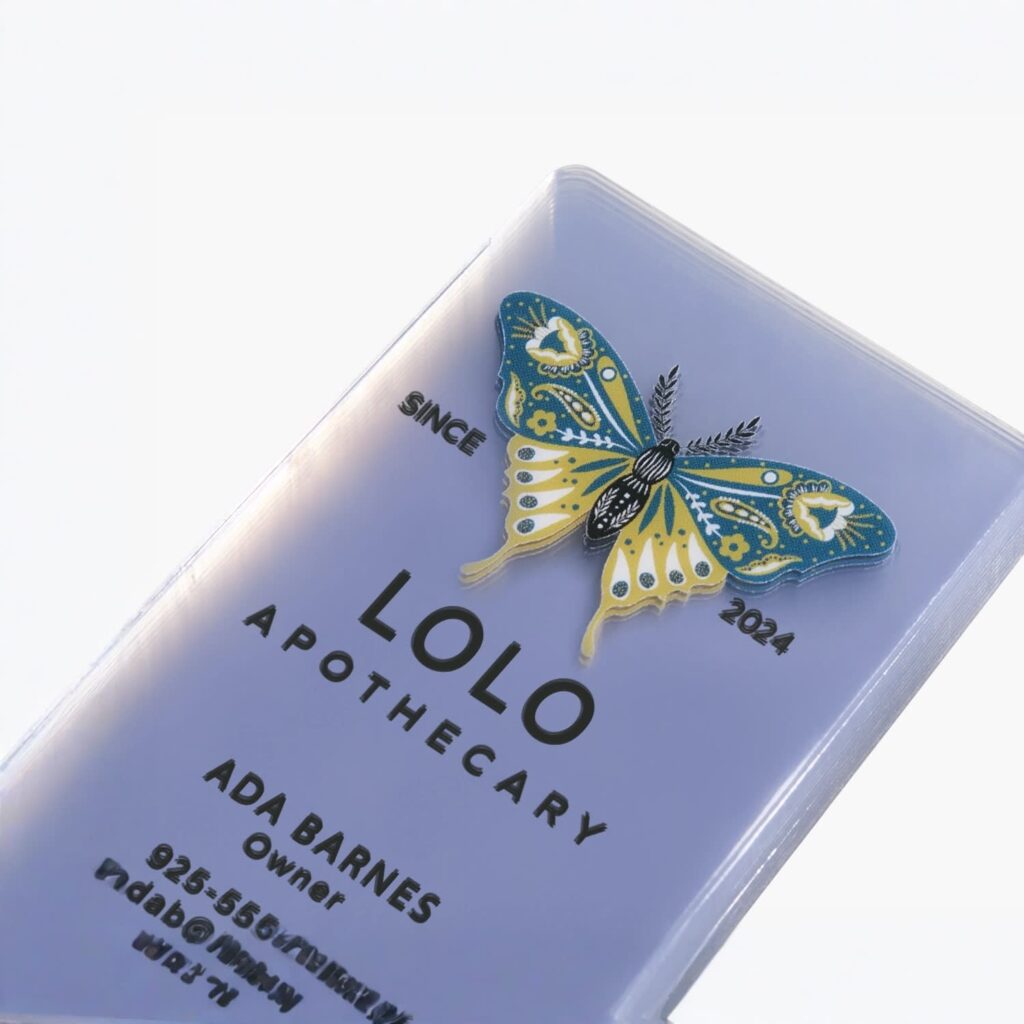
Plastic’s smooth surface can make fine print details less forgiving, so keep the artwork clean:
- Keep essential text at 8pt or larger to maintain legibility, especially with lighter typefaces.
- Avoid ultra-thin lines and intricate details that may reproduce less reliably on plastic.
- Use strong contrast to keep essential information readable, particularly on clear and frosted stock.
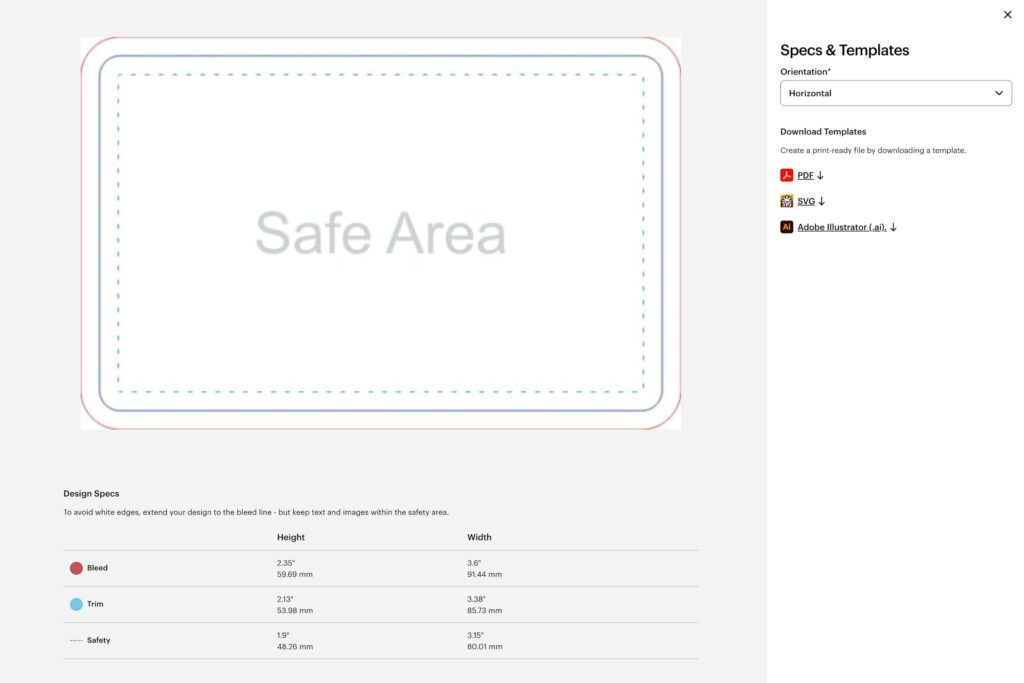
- Keep important elements inside the safe area to account for normal cutting tolerances.
- Extend edge-to-edge artwork through the required bleed if full-bleed printing is available for your chosen plastic card.
Design differently for white, clear and frosted plastic
The substrate changes how your artwork appears in print, so design with its opacity in mind:
- On white plastic: Use full-color photography, gradients and fine color differences much as you would on white cardstock. The opaque base gives you a consistent background for judging color and contrast.
- On clear plastic: Decide exactly which areas will remain transparent before laying out the design. Add a white ink layer beneath elements that need to appear opaque, if your printer offers it. Keep essential text away from transparent areas where whatever sits behind the card could reduce readability.
- On frosted plastic: Use stronger contrast for small text and fine graphics, since the translucent background can soften subtle color differences. Check lighter colors carefully rather than assuming they’ll read as they do against white.
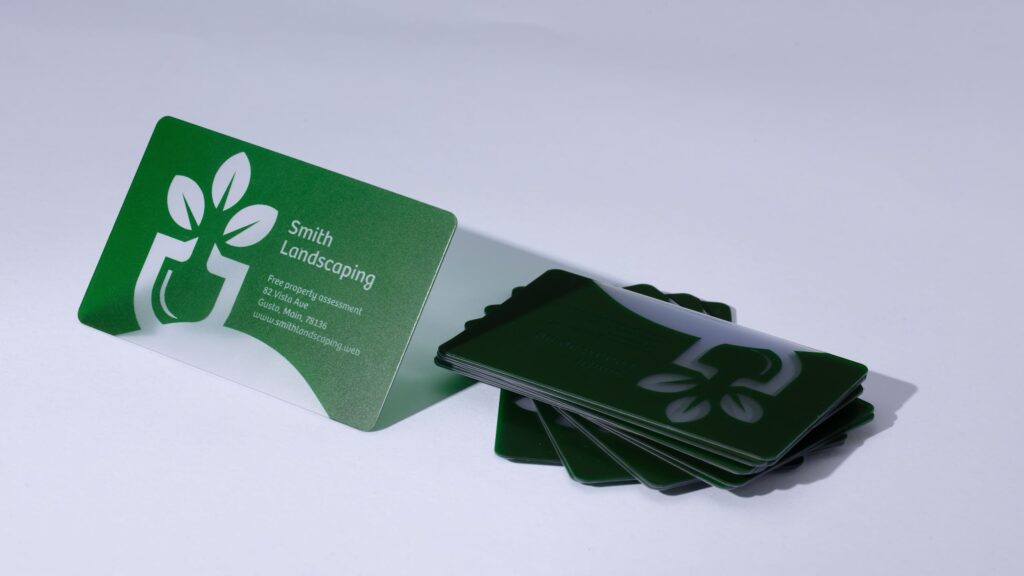
For clear and frosted cards, leave some substrate exposed if transparency is part of the concept. Covering the entire surface removes much of the effect.
Confirm white ink, double-sided printing and full-bleed options for the exact card before building the design around them.
Ready to upgrade to durable custom business cards?
Your print materials should suit the way your business actually works. If standard cardstock can’t keep up with your working environment, or you simply want a card with a more distinctive look and feel, plastic gives you a durable alternative without limiting your design options.
Waterproof business cards FAQs
How long do waterproof business cards last?
There’s no set lifespan. The material may resist water for years, but scratches, UV exposure, chemicals and frequent handling can wear down the printed surface sooner.
Can you write on waterproof business cards?
It depends on the surface. Standard pens can smear on smooth plastic, while some synthetic stocks are made to accept ink. If writability matters, check the product specs and test your preferred pen first.
Can waterproof business cards get scratched?
Yes. Waterproof doesn’t mean scratch-proof. Keys, tools, grit and repeated rubbing can mark the surface, so check abrasion resistance for cards destined for pockets, work bags or toolboxes.
Can waterproof business cards have QR codes?
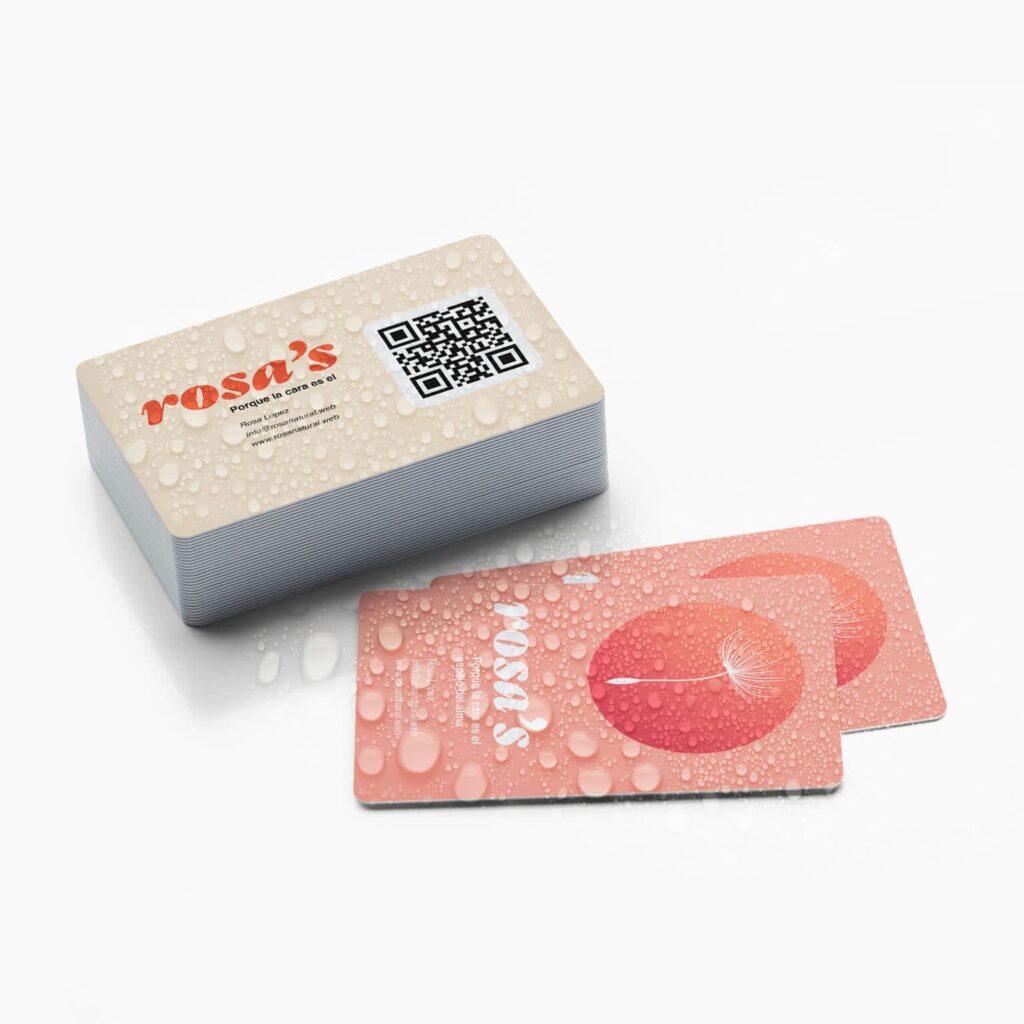
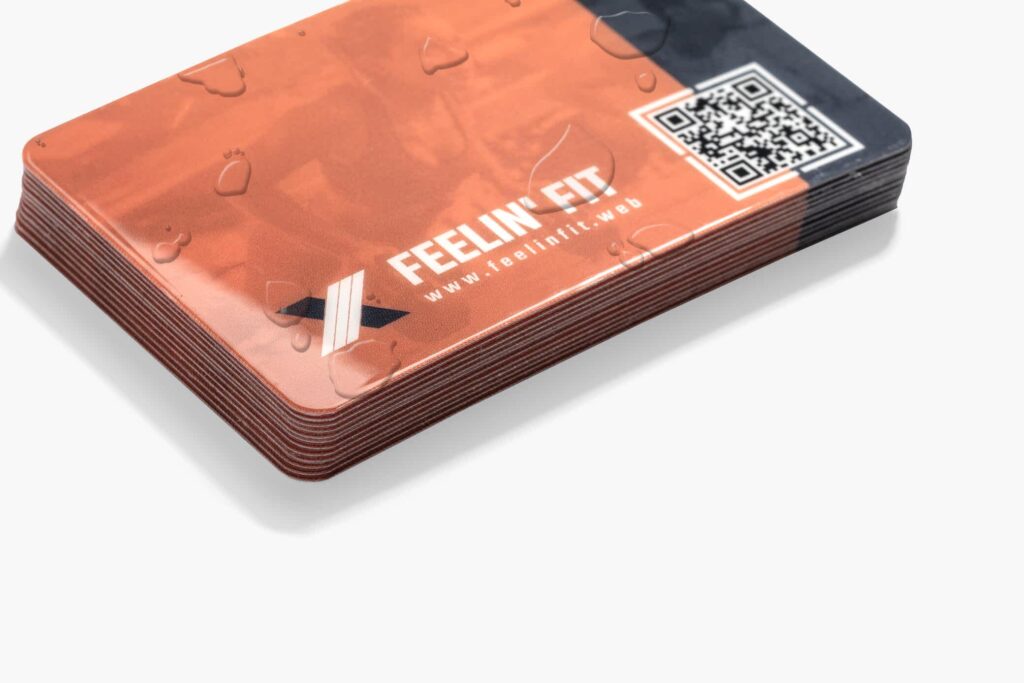
Yes. Use strong contrast and enough clear space around the code. On clear or frosted plastic, place it over an opaque background and test a printed sample to make sure it scans reliably.
Can waterproof business cards be printed on both sides?
Often, yes, but check the specific product. With clear plastic especially, printing on the back may show through to the front, so plan both sides together and check whether white ink is available.
Do durable business card finishes make paper cards waterproof?
Not necessarily. Glossy, matte and specialty finishes can add surface protection against moisture and wear, but they don’t automatically make the paper underneath waterproof.