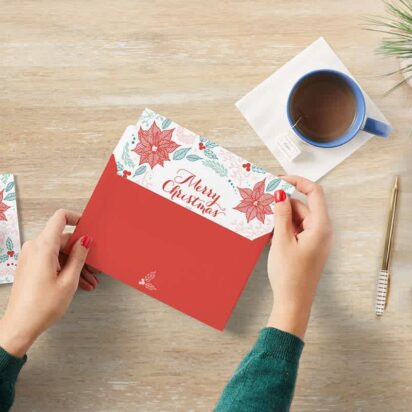
The same Christmas card design can feel completely different depending on the Christmas card paper you print it on. Before your recipient reads a single word, the paper’s weight, texture and finish have already created an impression of your business.
This guide explains the common paper weights for Christmas cards, the different types of paper used for Christmas cards and how to choose the right paper, finish and specialty details for your design.
- Choose 300-350 GSM (110-130 lb cover stock) for Christmas cards that feel sturdy, professional and built to last.
- Match the paper finish to your design: glossy suits photography and bold graphics, matte works well with typography and illustrations, while linen adds texture to minimalist and vintage-inspired designs.
- Don’t overlook sustainable paper stocks such as recycled, bamboo, hemp-blend, cotton or kraft if you want an environmentally conscious option without compromising print quality.
- Use foil accents, embossing and spot UV selectively to draw attention to greetings, logos or decorative details without overwhelming the design.
- Pair heavier cardstock with an 80-100 lb text-weight envelope to help your Christmas cards arrive in the same condition they left you.
Paper weight: What GSM is good for Christmas cards?
For most Christmas cards, 300-350 GSM (110-130 lb cover stock) is the best choice. It has the sturdy, premium feel people expect from a quality greeting card without being unnecessarily thick or expensive. If you’re only going to remember one number, make it this one.

Paper weight is one of those details people notice without realizing it. Pick up two cards with the same design and print quality, and the heavier one will almost always feel more polished and expensive. Choosing the right stock is a simple way to give any Christmas card – personal or business – a higher-quality feel.
But before we look at the common paper weights for Christmas cards, it helps to understand one printing term.
GSM (grams per square meter) measures the weight of the paper. The higher the GSM, the thicker and more rigid the stock. To put that into perspective, everyday printer paper is usually around 80 GSM, while Christmas cards are typically printed on cardstock starting at 250 GSM.
If you’re ordering from a North American printer, though, you’ll probably see cover weight (lb) instead of GSM. While both describe how substantial the cardstock is, they measure it differently. GSM refers to the weight of one square meter of paper; cover weight refers to the weight of 500 sheets of a standard-sized stack of cardstock.
There’s no exact conversion formula, but as a rule of thumb, 250 GSM is roughly 90 lb cover, 300 GSM is about 110 lb cover and 350 GSM is around 130 lb cover.
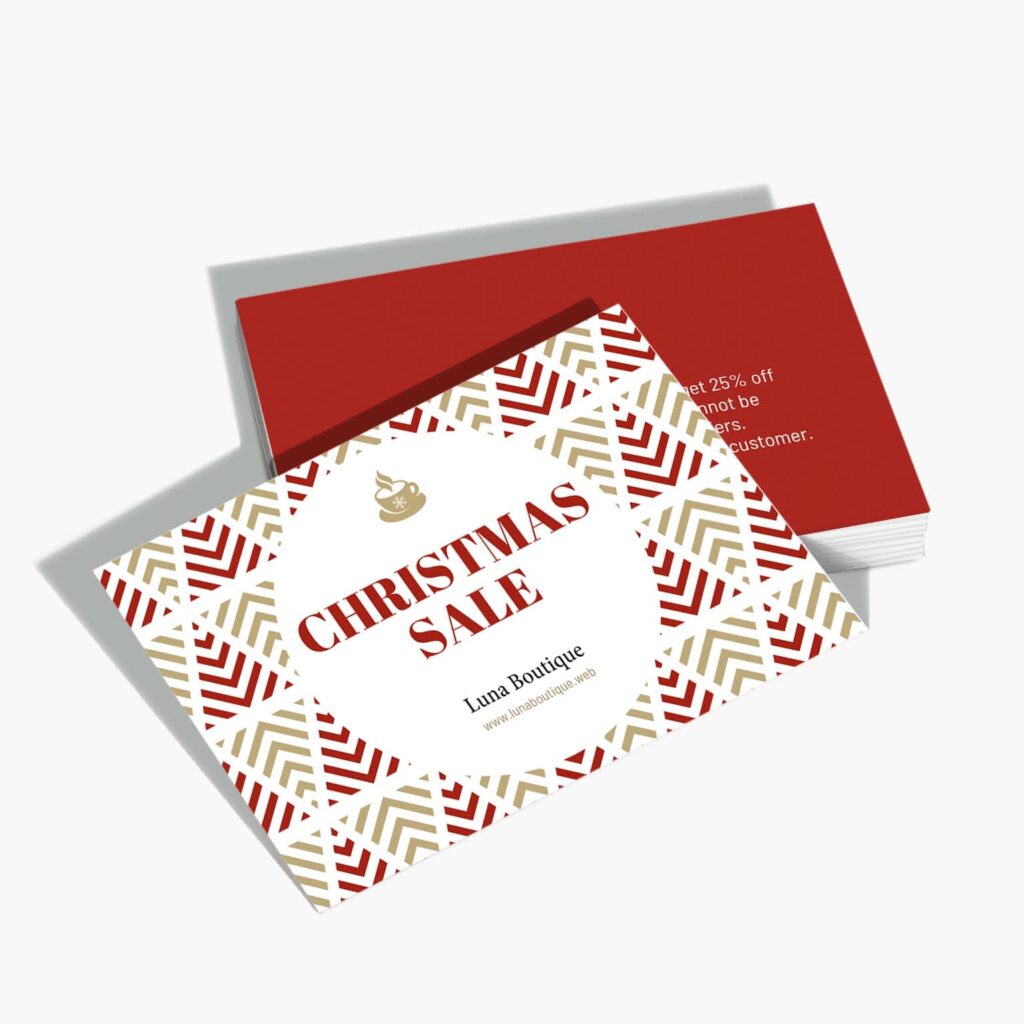
Here’s how the three most common paper weights for Christmas cards compare:
| Paper weight | Cover weight | Feel | Best for |
| 250 GSM | 90 lb cover | Light but sturdy | Folded mailers, promotional inserts and budget-friendly print runs |
| 300 GSM | 110 lb cover | Firm with the classic greeting card feel | Most business and personal Christmas cards |
| 350+ GSM | 130+ lb cover | Thick, rigid and distinctly substantial | Executive greetings, luxury brands and VIP mailings |
Types of paper used for Christmas cards: Matte, glossy and linen
Choosing the right paper weight is only half the decision. Once you’ve settled on the cardstock, the finish determines how the final design looks, feels and even how colors appear in print.
That’s why two Christmas cards printed on the same 300 GSM stock can look completely different. The right finish can make photos look richer, typography feel more refined or artwork stand out in a way the wrong finish simply won’t. It also affects practical details, from whether recipients can write inside the card to how well fingerprints, glare and everyday handling show up over time.
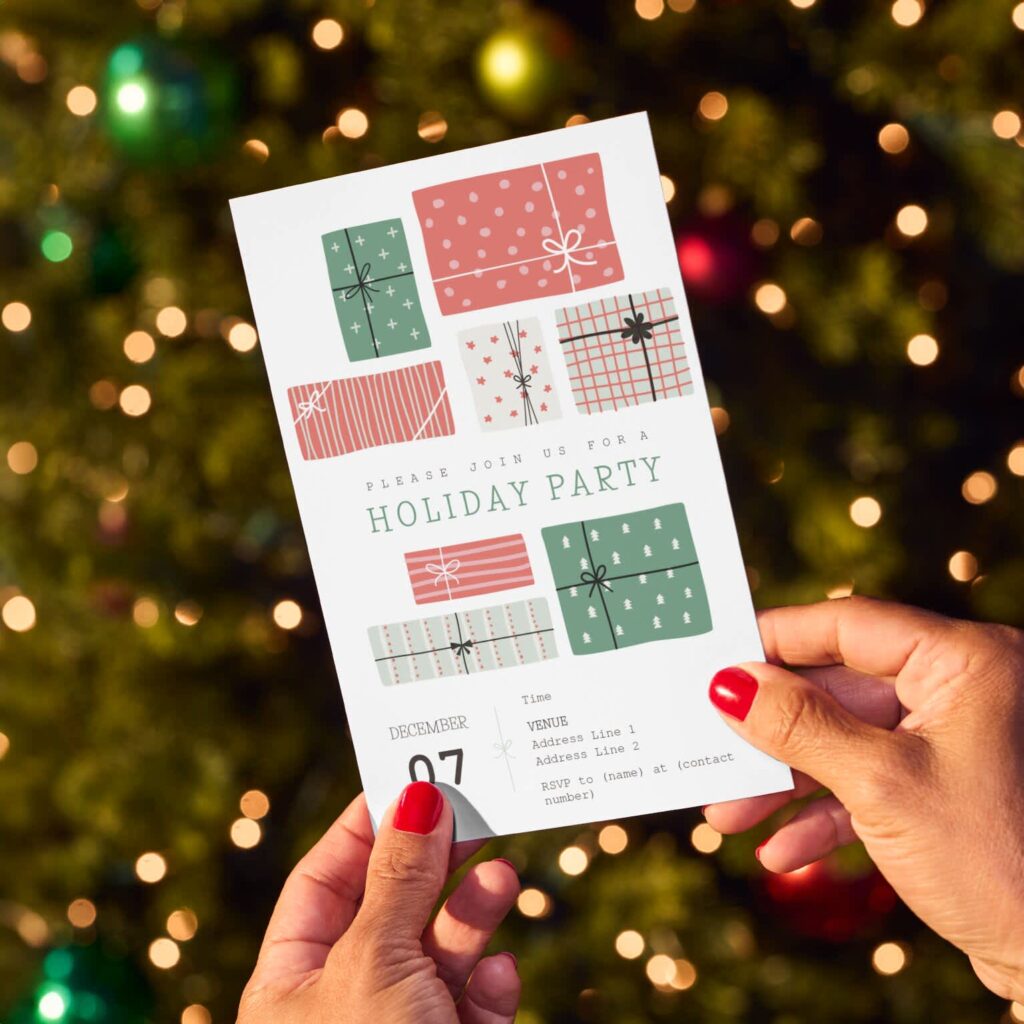
Glossy finish
If your Christmas card relies on photography, glossy is usually the strongest choice. The smooth coating deepens colors, increases contrast and gives images a crisp, vibrant look that immediately catches the eye. That’s why it’s a favorite for family photo cards, product photography and bold, graphic-heavy designs.
Best for: Vibrant photography, high-contrast graphics and full-bleed designs.
| Pros of glossy finish for Christmas cards | Cons of glossy finish for Christmas cards |
| Makes colors look richer and more saturated | Reflects light and can create glare |
| Brings out detail in photographs | Shows fingerprints more easily |
| Protective coating helps resist scuffs | Not ideal for minimalist designs or large areas of text |
Opt for photo-based Christmas cards if you want to appeal to younger audiences. Check out our Christmas card trends report for more insights.
Can you write on glossy Christmas card paper?
Yes. Most glossy Christmas cards are coated only on the outside, while the inside is left uncoated – so handwritten messages dry quickly without smudging.
If you’re ordering custom cards, though, it’s still worth checking the product specifications before you buy.
Always opt for uncoated card interiors if you plan to send handwritten messages to your clients. Uncoated paper absorbs ink quickly, preventing smudges.
Matte finish
If glossy is designed to stand out, matte takes the opposite approach. It has a smooth, non-reflective surface that softens colors slightly and keeps the focus on typography, illustrations and clean layouts.
Best for: Elegant typography, minimalist branding and traditional artwork.
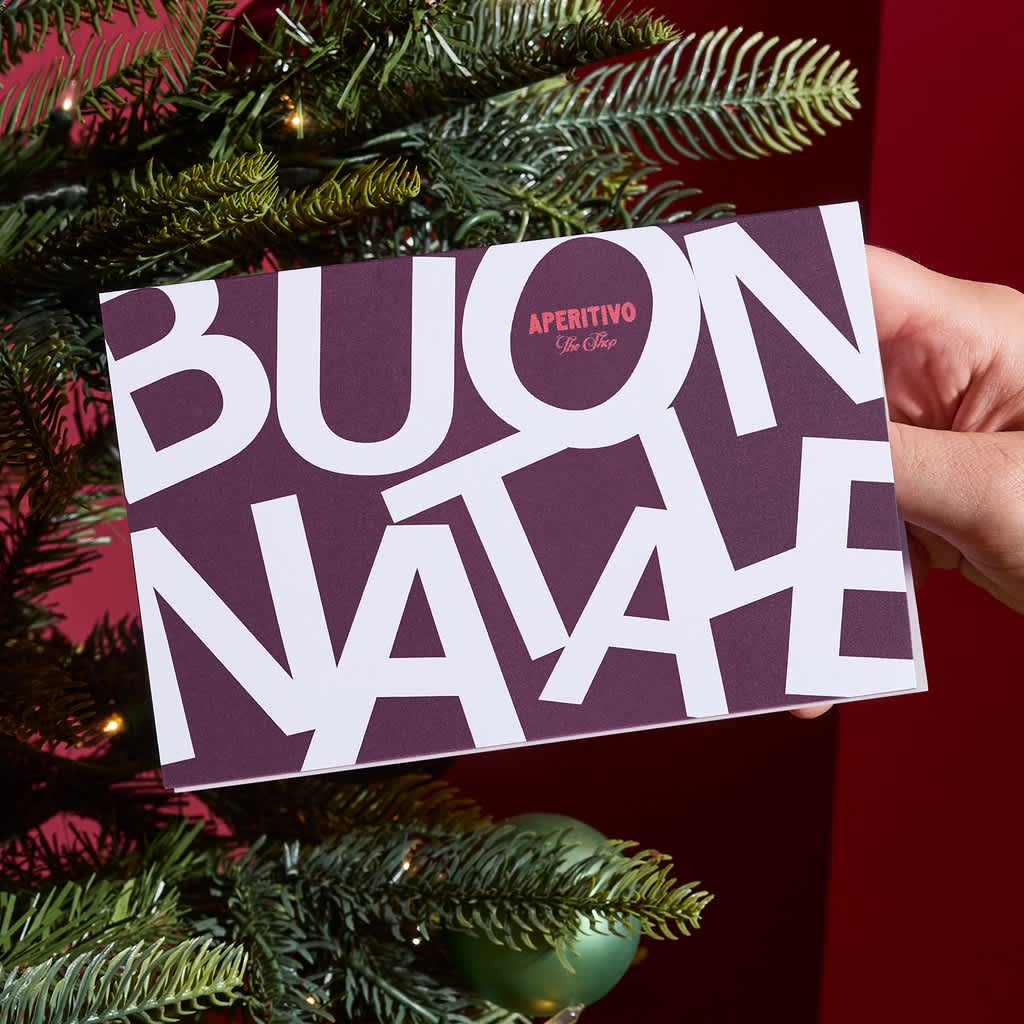
| Pros of matte finish for Christmas cards | Cons of matte finish for Christmas cards |
| No glare under bright lighting | Photos won’t appear as vibrant |
| Sophisticated, understated appearance | Colors look slightly softer than on glossy stock |
| Less likely to show fingerprints | Doesn’t create the same visual impact for photo-heavy designs |
Linen and textured paper stocks
Textured paper stocks, like linen, feature a fine cross-hatched weave that adds tactile depth. They excel when paired with fine art illustrations, minimalist branding and vintage-inspired holiday motifs.
Best for: Fine art illustrations, minimalist branding and vintage-inspired designs.
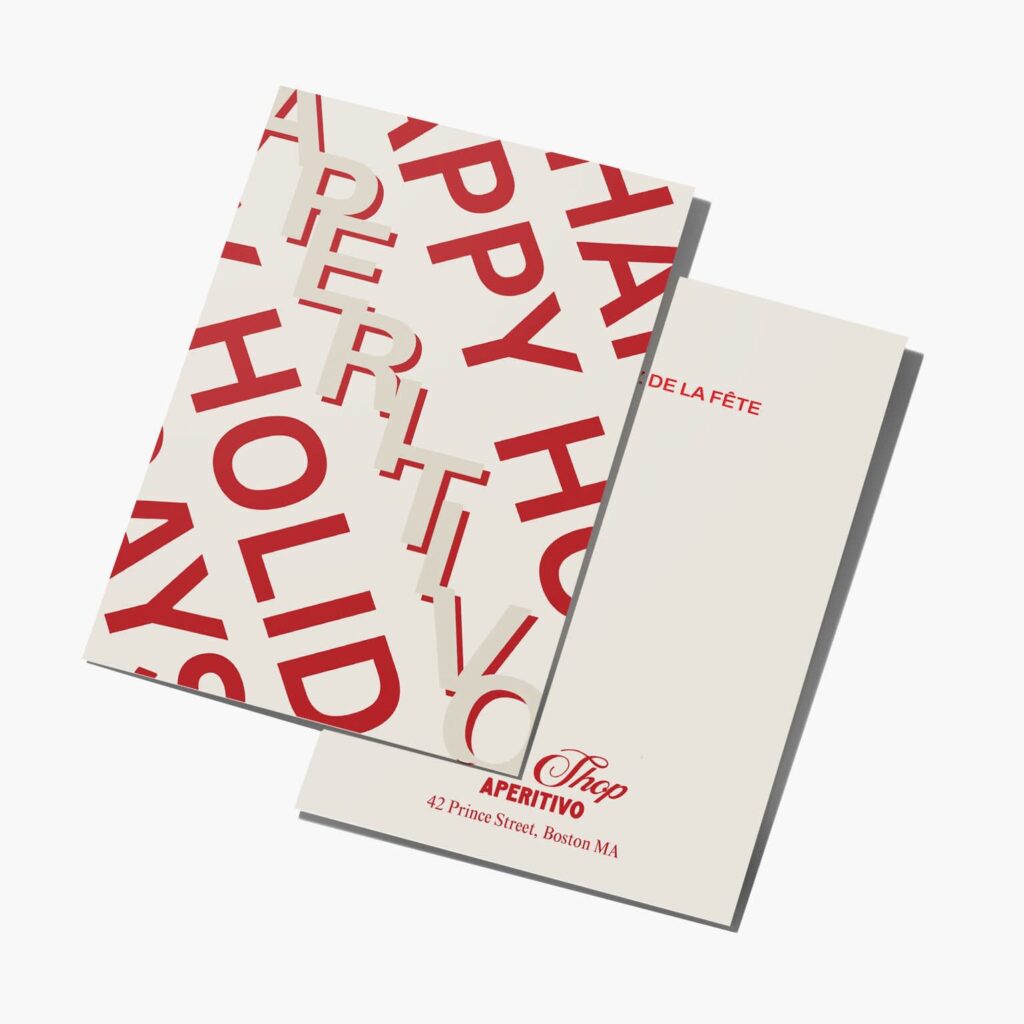
| Pros of linen and textured paper stock for Christmas cards | Cons of linen and textured paper stock for Christmas cards |
| Distinctive tactile finish | Fine textures can soften photo detail |
| Adds character without extra embellishments | Not the best choice for close-up portraits |
| Hides fingerprints well | Usually costs more than smooth stocks |
Are linen or textured paper stocks good for photo holiday cards?
Linen stocks work wonderfully for graphic designs, but they can break up fine facial details in high-resolution photo portraits.
Which Christmas card paper finish should you choose?
If you’re still deciding, this side-by-side comparison highlights where each finish performs best.
| Finish | Look & feel | Best for | Pros | Cons |
| Glossy | Smooth with a reflective shine | Photography, colorful graphics, full-bleed designs | Makes colors pop, keeps photos sharp, durable coating | Can create glare and show fingerprints |
| Matte | Smooth with a non-reflective finish | Typography, illustrations, understated branding | Elegant appearance, easy to read, fewer visible fingerprints | Photos won’t appear as vibrant |
| Linen / textured | Woven texture with a handcrafted feel | Fine art, vintage-inspired designs, minimalist branding | Adds tactile interest, hides fingerprints, feels distinctive | Fine photo detail can appear less sharp |
Choosing eco-friendly Christmas card paper stocks
If sustainability is part of your brand, many Christmas card stocks are now available in recycled or responsibly sourced options, so you don’t have to compromise on print quality to make a more considered choice.
Eco-friendly paper stocks are produced using post-consumer recycled fibers, responsibly sourced raw materials or lower-impact manufacturing processes.
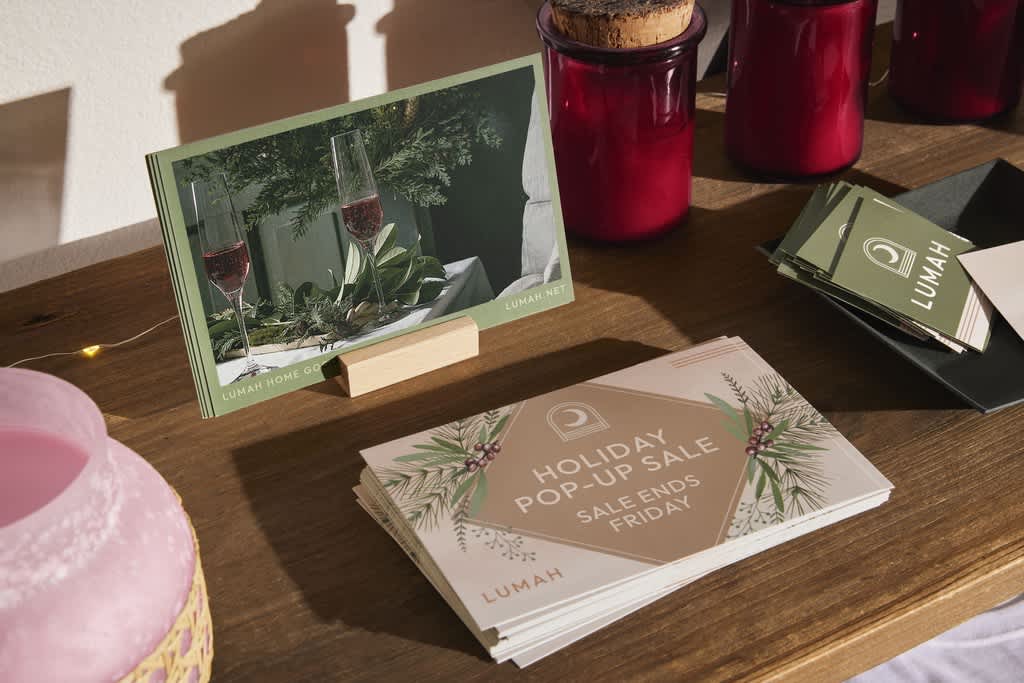
VistaPrint offers several sustainable paper stocks, including:
- Recycled paper: Made from post-consumer recycled fibers, offering a natural look and excellent print quality.
- Bamboo paper: Made from fast-growing bamboo fibers, offering a smooth surface and a refined finish.
- Hemp-blend paper: Made from a blend of hemp fibers and paper pulp, offering durability and a subtle natural texture.
- Cotton paper: Made from cotton fibers, offering a soft, luxurious feel for premium holiday greetings.
- Kraft paper: Made from unbleached wood pulp, offering a warm brown color and a rustic, lightly textured finish.
The paper you choose becomes part of the story your Christmas card tells. For businesses, choosing a recycled or responsibly sourced stock shows the same attention to detail as the rest of the design. It’s a subtle touch, but one that many customers notice and appreciate.
Does recycled Christmas card paper still look professional?
Absolutely. Modern post-consumer recycled cardstock delivers crisp color reproduction, excellent opacity and a soft, natural texture that works just as well for photography, illustrations and typography. Unless you point it out, most people won’t realize the card is printed on recycled stock.
Elevating card design with specialty finishes and foil accents
No matter which paper stock you choose, specialty finishes can make your Christmas card feel more polished and memorable. They add visual contrast and tactile detail that standard printing can’t achieve, drawing attention to key design elements without adding more color or clutter.
Specialty finishes and foil accents are just one way to make your Christmas card stand out in the mailbox. Get inspired by our list of custom Christmas card ideas for businesses.
Foil accents (gold, silver and rose gold)
Foil accents are a Christmas favorite because they catch the light in a way standard ink can’t. They’re most effective when used to highlight a single focal point rather than competing with the rest of the design.
Use foil to highlight:
- Holiday greetings, such as Merry Christmas or Season’s Greetings
- Your company logo or monogram
- Decorative borders or frames
- Small festive illustrations, such as stars, ornaments or snowflakes
Foil is particularly effective for client appreciation cards, executive greetings and other premium mailings where first impressions matter.
To keep the design cohesive, choose a foil color that complements your brand palette. Gold feels timeless, silver has a cleaner, more contemporary look and rose gold adds a softer finish.
If you’re using foil, simplify the rest of the design. Clean backgrounds and generous white space help metallic details stand out far more than busy patterns.
Embossed and spot UV finishes
Embossing creates a raised texture you can feel, while spot UV applies a clear gloss coating to selected areas of the design. Both draw attention through texture rather than color, making them ideal for logos, holiday greetings and simple decorative patterns.
They work best when reserved for one or two key elements. On matte cardstock, spot UV creates a striking contrast, while embossing adds depth that recipients notice the moment they pick up the card.
Pick one finish to take the lead. An embossed greeting paired with a foil logo feels intentional, while multiple finishes competing for attention can make even a simple design feel overworked.
Choosing the right envelope for your Christmas cards
Paper stock influences more than the finished look of your Christmas card. It also determines which envelope will protect it best during mailing.
Match your envelope to your cardstock
If you’re printing on 300-350 GSM cardstock, choose an 80 lb to 100 lb text-weight envelope. It’s strong enough to support heavier cards and helps prevent bent corners, creases and tears in transit.
For a more polished presentation, match the envelope to your cardstock’s color or texture.
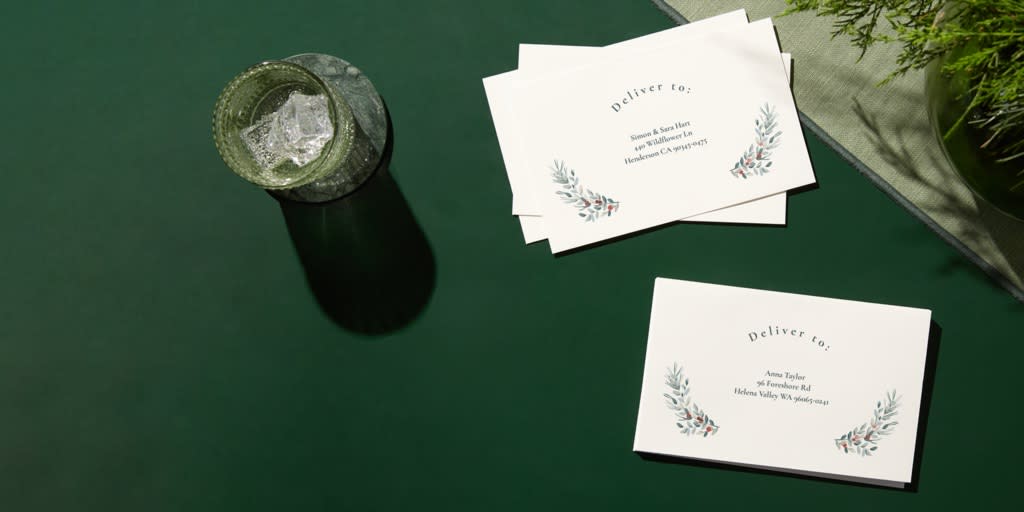
Order a few extra envelopes – you’ll almost always remember another recipient after you’ve sealed the last card.
Ready to put your Christmas card design on the right paper?
The details people remember aren’t always the ones they notice straight away. A Christmas card that feels substantial, prints beautifully and arrives in perfect condition leaves a stronger impression than one that feels flimsy or generic.
That’s why choosing the right paper matters just as much as the design itself, especially when Christmas cards are part of your holiday marketing campaign. The weight, finish and finishing touches all influence how your card is perceived, helping it reflect the quality and professionalism people associate with your brand.
Christmas card paper FAQs
Does heavier Christmas card paper cost more to mail?
Sometimes. A 300 GSM Christmas card usually falls within standard mailing limits, but very thick cardstock, multiple inserts or specialty embellishments can increase postage. If you’re sending a large batch of cards, it’s worth checking postal weight limits before placing your print order.
Can I use the same paper stock for every Christmas card design?
You can, but it isn’t always the best choice. Photo-heavy designs generally work best on glossy stock, while typography, illustrations and minimalist layouts often suit matte or textured papers better. Matching the paper to the design usually produces a stronger finished result than choosing one stock for every project.
Should my envelope match my Christmas card?
It doesn’t have to match exactly, but it should feel like part of the same package. Choosing a similar color, texture or paper weight creates a more polished presentation and gives recipients a better first impression before they’ve even opened the envelope.
How do I choose the right Christmas card paper for my brand?
Start with the overall style of your design. Glossy paper suits colorful photography, matte works well with clean typography and illustrations, while textured stocks create a more handcrafted feel. Then consider your audience.
A premium cardstock with subtle foil accents may be worth the investment for key clients, while a standard 300 GSM stock is a reliable choice for most business holiday cards.
Should I choose folded or flat Christmas cards?
Folded cards give you room for a handwritten message, making them a better choice for client appreciation and personal greetings. Flat cards work well when the design or photography is the main focus, or when you’re sending larger mailing campaigns where simplicity and lower postage costs matter.