
You’ve put care into your product, so you want it to arrive at your customer’s doorstep looking just as good as it did when you packed it. But choosing durable packaging also means thinking about what each box costs, where you’ll store it and how it feels when a customer opens it. A sturdy gift box might suit one product perfectly, while a simple folding carton with a protective outer mailer makes more sense for another.
This custom box packaging guide explains the differences, from board thickness and product weight to storage space and shipping costs. You can then choose a box that protects your product and suits your budget.
- Folding cartons commonly use 10–24 pt paperboard and ship flat. Consider them for lightweight retail products under 3 lbs, subject to the supplier’s specifications.
- Traditional rigid setup boxes use thicker board, often around 60–120 pt, and arrive assembled, so they need more storage space.
- Corrugated mailers are a useful starting point for 3–10 lb shipments, but fragile products may need them at much lower weights.
- A folding carton inside a corrugated outer box can combine attractive presentation with shipping protection, without the expense of a rigid gift box.

Understanding paperboard construction: Rigid boxes vs folding cartons
Folding cartons fold into shape from thin paperboard, rigid boxes have a thick board core and corrugated mailers have a fluted layer between sheets of paper.
| Box type | Typical construction | What that means for your product |
|---|---|---|
| Folding carton | Single-layer paperboard, usually 10–24 pt (about 0.25–0.61 mm) | Lightweight, printable packaging for retail display. Usually needs an outer box for parcel shipping |
| Rigid setup box | Grayboard or chipboard core, often 60–120 pt (about 1.5–3.0 mm), covered with paper | Firm walls and a substantial feel for gifts and premium products. Usually needs an outer shipping box |
| Corrugated mailer | Fluted paper between liners. E-flute is roughly 1/16 inch thick and B-flute roughly 1/8 inch | Added strength for shipping, with the grade, design and cushioning chosen for the contents |
These comparison ranges vary by supplier, so check the exact specification before ordering.
Choosing durable packaging paperboard
Caliper simply means thickness, and one point equals 0.001 inch. A thicker board generally resists bending better when you’re comparing the same material, but thickness alone doesn’t tell you how much weight a finished box can hold. Its size, bottom closure and board quality matter too.
Folding cartons suit cosmetics, accessories and small gifts well. Start with the product’s shape, then explore box packaging designs that leave enough room for clear branding and product information.
Rigid box chipboard thickness gives the walls their firmness, while the paper wrap creates the finished look. Popular styles include lift-off lids, sliding drawers and hinged magnetic closures. Custom rigid setup boxes usually arrive assembled, although collapsible rigid designs are also available.
Choosing packaging by product weight and fragility
Weight helps you narrow the options, but fragility and the supplier’s tested specifications will determine whether a package is suitable for shipping.
| Product weight or need | Starting point | What to check |
|---|---|---|
| Under 3 lbs, lightweight and sturdy | Folding carton for retail presentation | Bottom closure, fit and the supplier’s load guidance. Add an outer mailer for shipping |
| Around 3–10 lbs | Corrugated mailer or shipping box | Board grade, packed weight and support around the product |
| Over 10 lbs | Appropriately rated corrugated shipping box, potentially double-wall | Supplier guidance, reinforcement and testing with the full contents |
| Fragile or high-value, at any weight | Protective inserts and a suitable corrugated outer box | Cushioning and separation. Add a rigid inner box if the presentation justifies it |
Treat these bands as shopping starting points, not universal folding carton weight limits. A small glass perfume bottle needs more protection than a heavier sweatshirt, and a rigid gift box doesn’t automatically become a suitable shipping container because its walls feel solid.
When comparing packaging material durability, ask about edge crush testing (ECT), which measures the resistance of corrugated board to compression along its edges. Burst testing measures resistance to pressure through the board. But neither rating alone guarantees that a fragile product will survive a drop.
For electronics, glassware or heavy orders, ask your supplier about testing the complete packed box for its intended delivery journey. A packaging lab can advise on a suitable parcel test, for example, ISTA 3A, and you can build this into your packaging strategy before placing a large order.
Use VistaPrint packaging samples to compare the available materials, finishes and fit. Pack your actual product with its inserts – feeling the empty box is only the first step.
Comparing box costs, storage space and shipping
Folding cartons and corrugated mailers usually save storage space by arriving flat, while traditional rigid boxes take up their assembled volume before you fill them.
| Factor | Folding carton | Rigid setup box | Corrugated mailer |
|---|---|---|---|
| Relative unit cost* | Usually lower | Usually higher | Often between the two |
| Empty-box storage | Compact, flat bundles | Bulkier, assembled boxes | Flat stacks, thicker than folding cartons |
| Crush resistance | Limited, depends on board and structure | Firm walls, but not a shipping rating | Depends on board grade, fluting and box design |
| Transit role | Inner retail packaging | Presentation box inside a shipper | Outer protection, with suitable cushioning |
| Packing effort | Fold and close | Usually ready to fill | Fold, close and secure as specified |
| *Compare quotes at the same quantity, with equivalent print coverage and finishes. |
Work out your own storage savings
Imagine you need 500 boxes. If each assembled rigid box measures 8 × 6 × 3 inches externally, the boxes alone occupy about 41.7 cubic feet: 500 × 144 cubic inches, divided by 1,728.
If the supplier were to confirm that 500 comparable folding cartons arrive in bundles totaling 8.3 cubic feet, that’s about 80% less volume: (41.7 − 8.3) ÷ 41.7 × 100. This is an illustrative calculation, not an industry-wide saving – actual storage also depends on master cartons, pallets and usable shelf space.
Compare shipment dimensions and the full cost of boxes, inbound delivery, storage, inserts and packing labor. If folding adds 20 seconds per order, for example, 500 orders mean roughly 2.8 hours of extra work.
Watch the size of the finished shipment
Carriers may charge by dimensional weight – how much space a parcel occupies – when that exceeds its actual weight. Using a divisor of 139, a 12 × 10 × 6-inch package has a dimensional weight of about 5.2 lbs, rounded up to 6 lbs. Check your carrier’s service and account rules.
Flat delivery saves space before packing, but it doesn’t automatically reduce the cost of sending the filled box. Corrugated shipping box durability and a close, protective fit matter more at that stage. For retail deliveries, shelf-ready packaging may also help store staff unpack and display products efficiently.
Combining folding cartons, inserts and outer mailers
Hybrid packaging pairs a presentation box with a protective outer shipping box, so each layer has a clear job. For a skincare brand, that could mean a printed folding carton around each jar, a fitted insert to hold everything in position and a corrugated mailer around the set. Use the same cartons for store sales and online orders, adding more protection when needed. Depending on quantities and inserts, this can cost less than rigid gift boxes.
Choose the insert for the product: corrugated dividers separate items, molded pulp supports shaped products and suitable foam can cushion delicate surfaces. Tissue paper adds presentation and light scuff protection, but it isn’t a substitute for cushioning around glass. Products should stay secure without being squeezed against the outer walls.
VistaPrint’s custom corrugated mailer boxes use E-flute board, with options including 6 × 4 × 3 inches for compact orders and 9.5 × 7.75 × 4 inches for larger sets. Those are internal dimensions, so measure your retail carton plus its cushioning before choosing a size. It’s not advisable to use these mailers for very large or heavy items.
For the inner layer, compare reverse tuck product boxes for lightweight goods with lock-bottom styles where extra bottom support is useful. Coordinate both layers using these mailer box design ideas to plan the outside and opening experience together.
Add finishing touches where they count
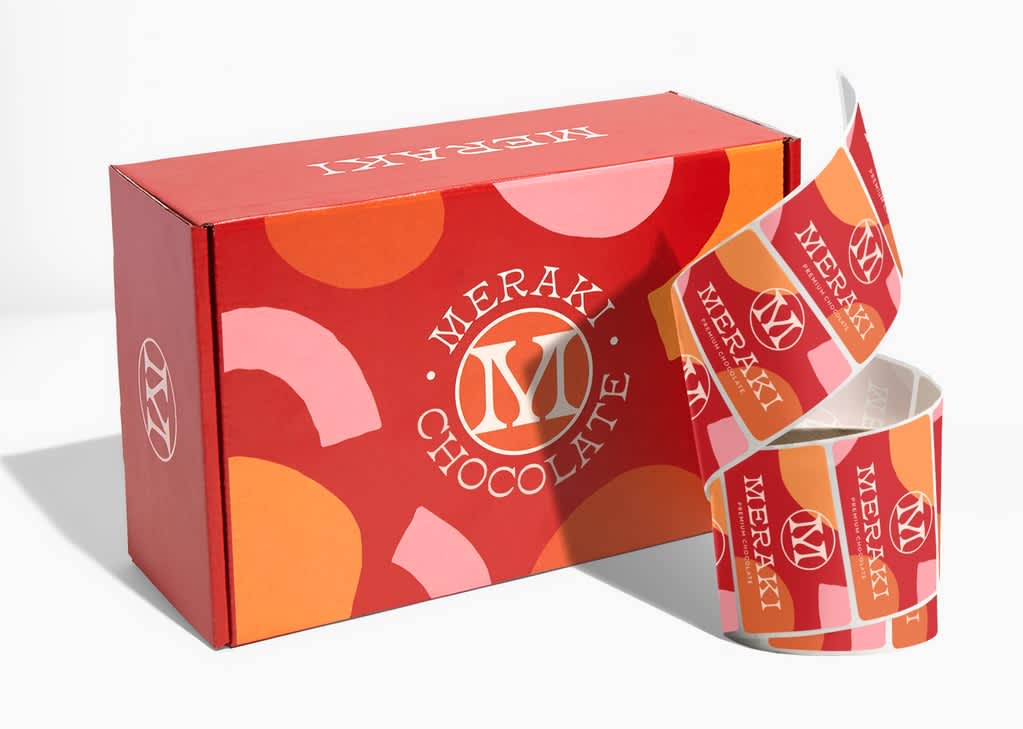
A sheet of custom tissue paper, closed with a branded sticker, can make a simple box feel considered. These label design ideas can help you tie the details together without printing every surface.
On retail shelves, prioritize clear product names and benefits. Foil stamping, spot UV or soft-touch lamination can add interest where your supplier offers them, while packaging design trends can give you ideas to adapt to your brand. For shipping, put delicate finishes inside the protective outer box.
If easier recycling is a priority for your customers, consider how coatings, plastic windows and inserts are accepted by local recycling facilities. Removable inserts and simpler material combinations can help your customers separate the parts more easily.
Finding the right box for your business
Start with what your product needs to arrive safely, then decide how you want your customers to experience it. A folding carton may be enough for a lightweight retail item, a corrugated mailer could handle an online order and a rigid inner box might make sense for a special gift – you can find inspiration in these brand packaging examples. Pack a sample, check its dimensions and compare costs. Durable packaging should fit your product, space and budget, while feeling like something you’re proud to send.
Durable packaging and shipping materials FAQs
What is the difference between a rigid box and a folding carton?
A folding carton uses thin paperboard that folds into shape. A traditional rigid box has a thicker board core covered with paper and usually arrives assembled.
Are rigid boxes more durable than folding cartons?
They generally resist bending better, but that doesn’t guarantee better shipping protection. Inserts, cushioning and an appropriate outer box still matter.
Which packaging material is most durable for shipping?
For everyday small-business parcels, properly specified corrugated board is a practical choice. Heavy or fragile goods may need double-wall construction and additional cushioning.
Do folding cartons ship flat?
Usually, yes. They arrive flattened for storage, often with a glued side seam, ready to be opened and folded into shape.
When should I choose a corrugated mailer instead of a folding carton?
Choose one when the box needs to handle parcel delivery. A folding carton can sit inside it if you also want separate retail packaging.
How much weight can a folding carton hold?
There’s no universal limit. Under 3 lbs is a starting point for considering lightweight retail cartons, but some designs hold much less. Confirm your supplier’s specifications before ordering.
Why are rigid setup boxes more expensive than standard cardboard boxes?
They use a thicker board and additional wrapping and assembly steps. Shipping and storing them assembled can also increase the total cost.